From Benefit Agreement to Balance Sheet: The Record Behind Indigenous Equity Ownership
A First Nation development corporation signs into a major project as an equity owner - a transmission line, a nuclear build, a pipeline - and overnight its balance sheet changes shape. The upside is real: a share of the returns from an asset that will run for decades. So is the obligation. The stake, the benefit-agreement commitments, and the conditions attached to the financing that made the investment possible all now live or die on one thing - a record that can prove what the Nation owns and track what it owes.
Indigenous equity ownership has moved from aspiration to routine in Canadian major projects, and the instrument driving it is the loan guarantee. But a guarantee, an equity stake, and a benefit agreement are not a single tidy document; they are a web of entitlements and obligations that a development corporation must hold together for the life of the asset. Who owns what percentage, and how does it change as the project draws down capital? What did the Nation commit to in the impact-benefit agreement - employment targets, procurement set-asides, environmental conditions, reporting - and are those commitments being met and evidenced? What covenants ride on the financing, and what happens to the distribution if one is missed? When those answers are scattered across law-firm files, a lender's data room, band-council resolutions, and a CFO's spreadsheets, the corporation's own ownership becomes hard to see - and an entitlement you cannot prove is one you may not fully collect.
Recent context
The scale is now concrete. In March 2026 the Canada Development Investment Corporation reported that the Canada Indigenous Loan Guarantee Corporation had issued its second guarantee under the federal program - backing Aamjiwnaang First Nation and the Chippewas of Kettle and Stony Point in acquiring a nearly 20 percent equity stake in the Chatham-to-Lakeshore transmission line. The federal Indigenous Loan Guarantee Program now stands at $10 billion, open to major projects across the economy, and by mid-2026 it was backing one of the largest Indigenous infrastructure investments in Canadian history in Ontario's Darlington nuclear build. Each transaction hands a development corporation both a durable asset and a multi-decade record-keeping duty.
The entitlement is only worth what the record can prove
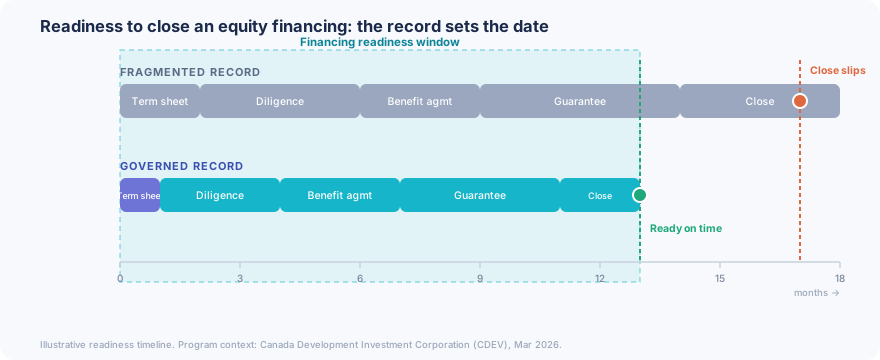
An equity stake looks like a number on a term sheet, but its value is realized through documents - the closing package that establishes the percentage, the shareholder and limited-partnership agreements that govern distributions, the loan-guarantee terms that set the covenants, and the benefit agreement that defines what the Nation gives and gets. Each distribution, each capital call, each compliance certificate either matches that record or raises a question, and questions between partners are settled by whoever can produce the cleaner file. The obligation side is heavier still: benefit agreements commit a Nation to deliverables tracked for years, financing carries covenants whose breach can suspend a distribution, and reporting to the guarantee corporation and to members is continuous. A development corporation that treats this as a filing task discovers the cost at the worst moment - a distribution delayed because a covenant certificate is missing, a benefit-agreement obligation unmet because no one was tracking it, a governance question from members that the record cannot answer. Handled well, the same record is also the corporation's strongest asset in the next deal: a Nation that can show a clean, well-governed ownership file borrows more cheaply and negotiates from strength.
How XNM helps
XNM helps a development corporation put the whole ownership and obligation record into one auditable command centre - the closing and equity documents, the benefit-agreement commitments and their status, the financing covenants, the distribution and capital-call history, and the reporting owed to the guarantee corporation, to partners, and to members, tied together and kept current. Where it helps, XNM-Vision gives the CEO and CFO a single line of sight over what the Nation owns, what it owes, and what is coming due - so a covenant certificate is ready before a distribution date, a benefit-agreement obligation is tracked rather than remembered, and a question from a member or the board is answered from the record rather than reconstructed. When the guarantee corporation, a lender, or an auditor asks for substantiation, it is already assembled. And because it stands up in days rather than months, the corporation controls the record from the first close, not after the first problem.
Practical takeaways
Anchor the ownership record at close. The percentage, the shareholder agreement, and the guarantee terms are the foundation of every distribution that follows; hold them where the CFO builds the numbers, not in a law firm's archive.
Track benefit-agreement obligations, don't remember them. Employment, procurement, and reporting commitments run for years; a live obligation register is what keeps a promise met and evidenced instead of missed and disputed.
Keep covenant certificates ahead of distribution dates. A missed or unproven covenant can suspend a payout; assemble the substantiation before it is asked for, not after a distribution is held.
Report to members from one governed record. Ownership on behalf of a Nation carries a duty to explain it; a single current picture lets the board and members see the stake and its returns without a reconstruction.
Make the file the asset for the next deal. A clean, well-governed ownership record lowers the cost of the next investment; treat it as capital, because a lender does.
FAQ
Our lawyers and lenders hold all these documents. Why does the development corporation need its own record?
Because the obligations are the Nation's, and so is the exposure if they lapse. A law firm keeps the closing file for the transaction; a lender keeps its data room for its own risk. Neither is tracking, day to day, whether your benefit-agreement commitments are being met or your next covenant certificate is ready. The development corporation is the only party whose job is to hold the whole picture - ownership and obligation - for the life of the asset.
We only hold one or two equity positions. Isn't a full record overkill?
The first position is exactly when the discipline is cheapest to build and most valuable to have. These investments run for decades and multiply as more projects open to Indigenous equity; a record built cleanly on the first deal compounds into a negotiating asset on the next. The overkill is discovering, on the third transaction, that the first two were never properly governed.
The bottom line
Indigenous equity ownership is one of the most consequential shifts in how major projects get built in Canada, and it hands each participating Nation both a stake and a stewardship. The stake is proven, and the stewardship is discharged, through the record - what is owned, what is owed, and what falls due next, held in one governed place. The upside is real; the record is how a development corporation makes sure the Nation actually collects it.