The Compounding Cost of a Design Error: Why Deliverable QA Outlives Closeout

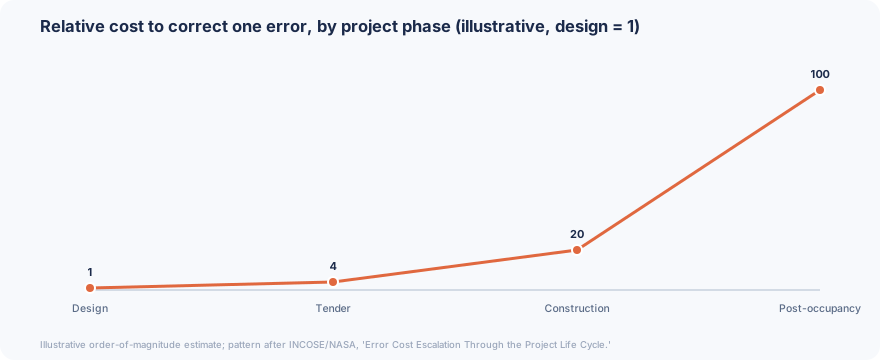
A dimension flagged during design costs an hour to fix. The same error found while tenders are out re-prices a bid. Discovered mid-construction, it buys a change order, a schedule hit, and an argument about who owns it. Discovered after the building is occupied, it can mean remediation, a professional-liability claim, and a mark on the firm's name. Nothing about the error itself changed from the first day to the last - only the cost of unwinding it. For an engineering or architecture firm, that single fact is the entire economics of quality assurance, and the curve keeps climbing well past the day the project closes.
Deliverable QA is not a box checked before a set ships; it is the discipline that decides where on that cost curve an error gets caught. When a firm seals a drawing, it accepts a duty of care that outlives the contract, the warranty, and often the building's first owner. A design decision made this year can surface as a demand letter years later, and by then the only thing between the firm and the claim is the record it can produce. Quality caught early protects the project; the record kept complete protects the firm.
Recent context
The exposure is real enough to have its own institutions. Pro-Demnity, the Ontario Association of Architects' professional-liability insurer, wrote in its February 2026 annual update that its purpose is to protect designed work, defend architects' professional judgment, and advance practices in an increasingly complex risk environment, with expert defence and claims support at its core. A dedicated insurer exists precisely because a design decision can return as a claim long after the drawings were sealed - and because, when it does, a firm's defence is only ever as strong as the file it can put on the table years later.
Why the cost curve steepens
The escalation is not mysterious. In design, correcting an error means changing a line and re-checking a calculation - nothing downstream is committed. At tender it distorts pricing and scope. In construction, materials are ordered and crews mobilized, so the fix carries not just its own cost but the cost of everything built on top of the mistake. After occupancy it is no longer a construction problem at all, but a performance failure, warranty dispute, or safety question argued under a limitation clock that can run for years. Each phase adds committed cost the last did not - which is why the earliest catch is always the cheapest.
How XNM helps
XNM helps engineering and architecture firms hold the full deliverable and project record in one auditable command centre - drawings and their revision history, calculations, specifications, RFIs, review comments, and the approvals that closed each one, organized by project and kept current. Where it helps, XNM-Vision makes the current revision unmistakable so QA runs against the right set, preserves the reasoning behind each decision, and keeps the file defensible long after closeout - so more errors are caught on the cheap side of the curve, and a complete, time-stamped record is producible the day a claim arrives. It stands up in days, not the months a document-control overhaul usually takes.
Practical takeaways
Push detection as far left as it will go. Every phase an error survives multiplies the cost of fixing it; the cheapest QA dollar is the one spent before tender.
Treat the record as part of the deliverable, not overhead. The sealed set is the product and the defence at once - budget for keeping it complete the way you budget for producing it.
Keep the reasoning, not just the result. A calculation without the review that checked it, or a revision without the RFI that drove it, is half a defence; capture why, not only what.
Assume a claim long after closeout. Limitation periods run for years - keep every project file complete and time-stamped so a future demand meets a defence, not a scramble through inboxes.
Make QA a system, not a hero. Consistent deliverable review should not depend on one diligent principal; build the discipline into how every set ships.
FAQ
We already run a QA/QC checklist before drawings go out. Isn't that enough?
A checklist governs the moment a set ships; the liability lasts far longer than that moment. The gap most firms carry is between 'we reviewed it then' and 'we can prove what we reviewed, and why, years from now.' The checklist catches errors on the cheap side of the curve - which is the point - but the durable, retrievable record is what turns that same review into a defence when a claim lands long after the file went quiet.
Isn't long-tail liability just what insurance is for?
Insurance pays the claim; the record decides how the claim goes. A defence assembled from scattered emails after a demand letter is the weakest position a firm can be in, and it raises the cost of every claim it touches. A complete, time-stamped project file is the strongest - it shortens disputes, supports the insurer, and often keeps a weak claim from becoming an expensive one. Coverage and record are not substitutes; the record is what makes the coverage work.
The bottom line
The cost of an error is set less by the error than by when it is caught, and the meter does not stop at closeout - a sealed drawing can return as a claim years down the road. The firms that protect both their margin and their name are not the ones with the cleverest tools; they are the ones whose quality was caught early and whose record was never in doubt. Deliverable QA is not paperwork around the work. For a consulting firm, it is how the work stays defensible for as long as the duty of care runs.