Working From the Wrong Drawing: Why a Firm's Record Is Its Margin
A crew pours a slab from a drawing marked Rev C while the structural engineer is three revisions ahead at Rev F. Nobody was careless; the current set simply did not reach the field in time. Days later the rework order arrives, and with it the argument over who owned the mistake. For a contractor that is a bad week. For the engineering or architecture firm whose seal is on the drawing, it is something more serious - a hit to margin, a strained client relationship, and a liability that can outlive the project by years. The document set is not paperwork around the work. For a consulting firm, it is the work.
Engineering and architecture firms run on version control the way an airline runs on maintenance logs. Across dozens of concurrent projects, a firm juggles drawings, specifications, calculations, requests for information, change orders, shop-drawing reviews, and sign-offs - multiplied by every subconsultant and every revision. When the single current revision of a document is not obvious and instantly findable, the firm absorbs the cost in three places at once: rework on the active job, disputes when stories diverge, and exposure when a claim surfaces long after the ribbon is cut. The firms that protect their margin are the ones that protect their record.
Recent context
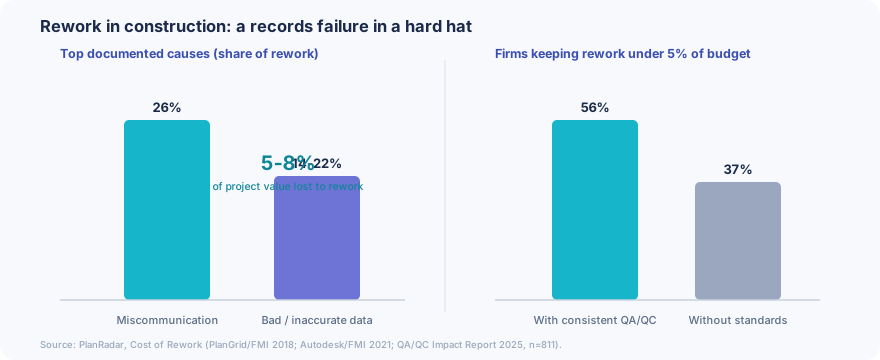
The cost is well documented. An industry review of rework data compiled by PlanRadar finds that rework typically runs 5 to 8 percent of total project value, that miscommunication causes about 26 percent of all rework and bad or inaccurate data another 14 to 22 percent, and - in its 2025 QA/QC Impact Report of 811 professionals across 13 countries - that firms with consistent quality records keep rework under 5 percent of budget far more often than those without standards (56 percent versus 37 percent). Rework, in other words, is mostly an information failure wearing a hard hat.
Rework is a records failure in disguise
Strip away the dust and most rework is a document that was wrong, missing, or stale at the moment someone acted on it. That reframing matters because it points to a fix a firm actually controls. You cannot eliminate site conditions or a client's late scope change, but you can guarantee that everyone is working from the one current set - and that every superseded revision, every RFI answer, and every change order is captured against the project where it belongs. The same governed record does double duty on the liability side. Professional limitation periods mean a claim can land years after the drawings were issued, and the firm's defence is only as good as the file it can produce. A reconstructed record assembled from inboxes after a demand letter arrives is the weakest possible position; a complete, time-stamped project file is the strongest.
How XNM helps
XNM helps engineering and architecture firms put the whole project record in one auditable command centre - drawings and their revision history, specs, RFIs, change orders, reviews, and approvals, organized by project and kept current. Where it helps, XNM-Vision makes the current revision unmistakable, preserves the full version trail behind it, and keeps the file defensible long after closeout - so the firm spends less on rework, argues less about who said what, and can produce the complete record the day a claim arrives. The aim is not another drive to search; it is the single governed set that the active project, the client, and a future dispute all depend on - stood up in days, not the months a document-control project usually drags into.
Practical takeaways
Make the current revision unmistakable. If anyone has to ask which set is live, you have already paid for the next rework order; one source of truth per project ends the question.
Keep the full version trail, not just the latest. The superseded revisions are your evidence; a claim turns on what was issued when, and that history has to survive.
File by project, not by inbox. A record scattered across email is one you will reconstruct under pressure; one you build as you go is one you can simply produce.
Treat QA/QC as a system, not a heroics. The data is clear that consistent quality records cut rework - so make the discipline structural, not dependent on one diligent reviewer.
Assume a claim years from now. Limitation periods are long; keep every project file complete and time-stamped so a future demand meets a defence, not a scramble.
FAQ
We use a shared drive with a clear folder structure. Isn't that version control?
Folders tell you where a file lives, not which revision is authoritative or who approved it. The failures that drive rework happen in the gap between 'the file exists somewhere' and 'everyone is certainly working from the current one.' Real version control makes the live revision unambiguous and keeps the trail behind it - that is the part a folder tree cannot guarantee.
Does this slow down fast-moving projects?
The opposite. The time tax is in chasing the right drawing, reconciling conflicting sets, and redoing work built on a stale one. A single current record removes those frictions; the discipline pays for itself the first time it prevents one rework order or shortens one dispute.
The bottom line
For a consulting firm, the drawing set is the deliverable and the defence at once - and 5 to 8 percent of project value rides on keeping it straight. The firms that hold their margin are not the ones with the cleverest design tools; they are the ones whose record was never in doubt. Version control is not a filing habit. It is how a firm protects its profit and its name in the same move.