Field Notes: Engineering Firms Scale on Their Records
Ask an engineering firm what it sells and you'll hear "expertise." Watch what actually leaves the building and gets invoiced, and it's something more concrete: a stamped drawing, a sealed calculation package, a signed report. The expertise is real, but the deliverable — the thing the client pays for and the thing the firm is liable for — is the document. Which means the unglamorous question of how a firm manages its documents isn't back-office housekeeping. It's the business.
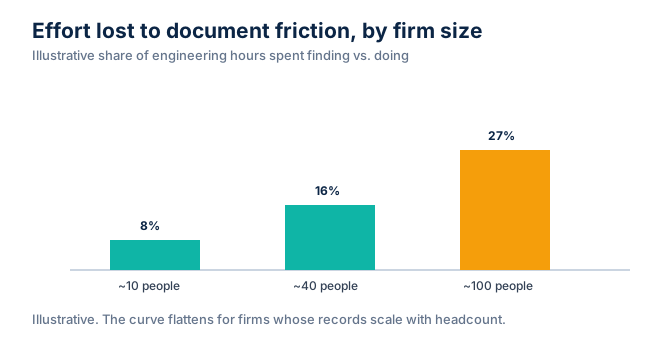
This is the part that surprises firms as they grow. The constraint on getting bigger is almost never raw talent. It's whether the firm can find, trust, and reuse its own record across dozens of concurrent projects and years of completed ones. A ten-person firm holds its documents in a handful of heads and a shared drive everyone half-remembers. A hundred-person firm can't. Somewhere in between, the filing approach quietly becomes the thing capping the firm's growth — and most firms don't notice until they're already straining against it.
The deliverable is the record, and the record is the liability
An engineering document is unusual: it's both the product and the proof. The stamped drawing is what the client builds from, and it's also what a court would examine if something failed years later. That dual role raises the stakes on every document the firm produces. You don't just need to deliver it; you need to be able to retrieve the exact version you stamped, with the calculations behind it, long after the project is closed and the engineer who sealed it has moved on. A firm that can't reconstruct what it stamped and why is carrying a risk it can't see.
That's why engineering, more than most fields, lives or dies on version discipline and traceability. The right answer to "which revision did we issue, and what backed it up?" can't be a guess. It has to be a record — findable, complete, and tied to the calculations and decisions that produced it.
Reuse is where document management pays for itself
Here's the upside that gets missed. A firm's past work is its most valuable and least-used asset. The detail you engineered three years ago, the calculation approach that worked on a similar structure, the report template that satisfied a tough regulator — all of it is reusable, if you can find it. The firm that can pull its own precedent in minutes wins work faster, prices more confidently, and stops paying senior engineers to re-solve problems the firm already solved. The firm that can't find its precedent does the work again from scratch, and never even realizes what it's spending.
Treat documents as infrastructure, not filing
The firms that scale cleanly make one mental shift: they stop thinking of document management as where finished work goes to rest, and start treating it as the infrastructure the whole firm runs on. One controlled home for every deliverable. Versions that can't fork. A record tied to the calculations and decisions behind it. Past work that's findable by the next project, not buried by it. This is exactly the kind of backbone XNM-VISION was built to give organizations whose deliverable is the document — and it's the difference between a firm that gets heavier as it grows and one that gets stronger.
If you run or work in an engineering firm, here's the test worth running this week: pick a project you closed two years ago and try to pull the exact stamped revision and the calculations behind it. How long does it take, and how sure are you it's the right one? That number is a quiet measure of how far your firm can scale before its own records start holding it back.
We write a Field Note on a different sector's records reality every week — see how the same problem looks across the industries we serve.