The Version That Went to the Wrong Crew
The crew framed the wall exactly to the drawing in front of them. Plumb, square, on schedule, done right. The only problem was the drawing. It was three revisions out of date, printed weeks earlier and taped to the trailer wall, and it showed a doorway where the current set showed solid structure. By the time the inspector caught it, the wall was up, the conduit was in, and the question on everyone's mind was simple and expensive: how did the wrong paper end up in the right hands?
Here is the part that should worry you. Nobody made a mistake you could point to. The engineer issued the revision. The site had a set. The crew followed the set in front of them, which is exactly what good crews do. And still the building went up wrong, because two versions of the same drawing were alive at the same time and nothing in the process forced the old one to die. By the end of this you'll see why the rework wasn't a field error at all — it was a distribution failure that started in an office three weeks before the first stud went up.
Two live versions is one version too many
A drawing set is only useful if there is exactly one current version and everyone who needs it has that one. The moment a second version is in circulation — a printout from last month, a PDF a sub downloaded before the latest issue, a marked-up copy someone kept "just in case" — you no longer have a drawing set. You have a guessing game. And on a busy site, people don't stop to check the revision block in the corner of a sheet they've been working from all week. They trust the paper in front of them, because trusting the paper is how the job gets done.
That is the trap. The reliability of a crew works against you when the document is wrong. A careless crew might have caught the discrepancy by accident. A disciplined one builds exactly what the bad sheet says, fast and flawless. The better your field people are, the more it costs you when the wrong revision reaches them — because they will execute it perfectly.
The revision lived in an inbox, not a system
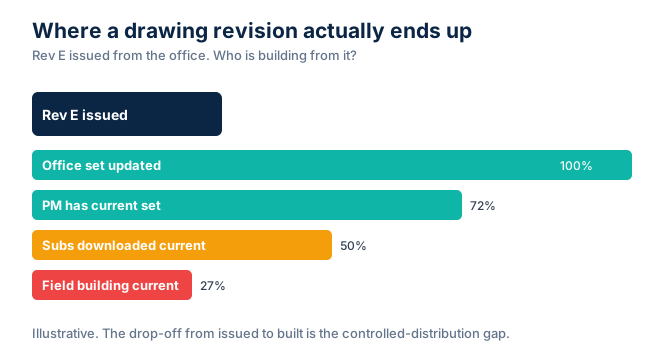
Trace the failure back and it almost always lands in the same place: the current revision existed, but it lived somewhere the field couldn't see. It was attached to an email sent to four people, one of whom was on vacation. It was in a folder named with a date nobody could parse. It was issued, but never distributed in a way that pulled the old version out of circulation. Issuing a revision and distributing a revision are two different acts, and projects routinely do the first while assuming it counts as the second.
Controlled distribution closes that gap. It means there is one place the current set lives, every superseded sheet is stamped and removed, and there is a record of who holds which revision. When a new revision drops, the old one is not just replaced — it is visibly killed, so no one can build from it by accident. Without that, "we issued Rev E" is a statement about your outbox, not about what is taped to the trailer wall.
Kill the old version on purpose
The discipline that prevents this is not glamorous. One current set, in one place the whole project reads from. Every superseded revision stamped SUPERSEDED and physically pulled. A transmittal record that says who received which revision and when. When the field has a question, the answer is never "check your email" — it is "open the current set," and there is only one. Keeping one controlled, current source of truth for every drawing and document is exactly the problem we built XNM-VISION to take off people's plates, but the principle works with nothing more than a rigorous transmittal log and the willingness to walk the site and tear down old paper.
So look at your own job this week. If a crew leader asked for the current structural set right now, how many places could it come from, and how would they know they had the latest? If the honest answer is "they'd probably have the right one," you don't have version control. You have a wall waiting to be built twice. The fix isn't to issue revisions faster. It's to make sure the moment a new one exists, the old one can't survive.
We trace a different one of these failures back to its root every week in our Anatomy of an Overrun series.