Winning Work, Keeping Knowledge: Why a Consulting Engineering Firm Runs on Its Record
Canadian consulting engineering is staring at a generational opportunity. A federal infrastructure push, a new Major Projects Office, and a nation-building agenda have put an unusual amount of work on the horizon for the firms that design the country's roads, water systems, bridges and buildings. But an opportunity is not a contract, and a contract is not a finished project. Two quieter things decide whether a firm actually captures this moment: whether it can win the work, and whether it can deliver it as the people who hold its expertise begin to retire. Both run on the same thing - the firm's record.
A consulting firm's record does double duty most owners underrate. On the front end, it is how the firm wins: every proposal leans on documented past projects, qualifications, references and lessons learned, and the firm that can assemble that evidence quickly and accurately out-competes the one reconstructing it from memory the week a submission is due. On the back end, the same record is the firm's institutional memory - the calculations, design decisions, review comments and as-builts that let the next engineer pick up where the last one left off. When that record is scattered, a firm pays twice: weaker, slower proposals, and knowledge that walks out the door with every retirement.
Recent context
The scale of the opportunity is on the record. Marking National Consulting Engineering Day in May 2026, the Association of Consulting Engineering Companies reported that the sector contributes close to $70 billion to the economy and supports nearly half a million jobs, set against roughly $115 billion in federal infrastructure spending over five years and what ACEC president John Gamble called a 'generational opportunity to build with vision.' The work is coming; the question is which firms are organized to take it.
The pipeline meets a retirement wave
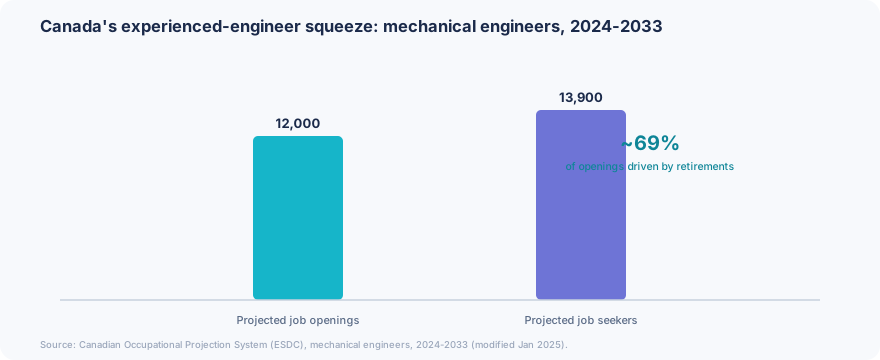
The same demographic strength that built that expertise is now its risk. The federal Canadian Occupational Projection System projects a near-even balance of job openings and job seekers for mechanical engineers from 2024 to 2033 - but about 69% of those openings come from retirements, in line with engineering's aging senior ranks. Civil and electrical disciplines tell a similar story: the shortage is concentrated not at the entry level but in the eight-to-fifteen-year band of experienced engineers. Every one of those departures is a body to replace and a library of undocumented judgment to lose - unless the firm's record already holds it.
How XNM helps
XNM helps engineering and architecture firms keep the whole knowledge and pursuit record in one auditable command centre - past-project files, qualifications and references for proposals, alongside the calculations, design decisions, reviews and as-builts that carry expertise forward, organized by project and kept current. Where it helps, XNM-Vision lets a principal assemble a credible proposal from the firm's real track record in hours rather than days, and lets a project lead step into a file a retiring colleague built and find the reasoning, not just the drawings. The aim is not another archive to search; it is the living record that lets a firm win the next pursuit and keep the knowledge behind the last one - stood up in days, in time for the pipeline that is already arriving.
Practical takeaways
Treat past projects as a pursuit asset. Your win rate depends on how fast and accurately you can prove relevant experience; a current, searchable project record is a competitive advantage, not just history.
Capture the reasoning, not just the deliverable. The drawings survive; the judgment behind them usually does not - record the why so the next engineer inherits decisions, not guesses.
Plan for the retirement, not around it. When a senior engineer's exit is years of knowledge leaving, the handover is a records task that has to start long before the farewell.
Make institutional memory a system, not a person. If critical project knowledge lives in one veteran's head, the firm's continuity does too; move it into a record the whole firm can reach.
Connect winning the work to delivering it. The proposal you won on past performance is the project that creates next year's past performance - keep both in one record so each feeds the other.
FAQ
We keep all our project files on a shared drive. Isn't our knowledge already captured?
Stored is not the same as captured. A drive holds the deliverables - the drawings, the final report - but rarely the reasoning: why a design path was chosen, what a review flagged, what went wrong and how it was fixed. That judgment is what retires with a senior engineer, and a folder of final PDFs does not hold it. The record that protects a firm captures the decisions, not just the documents.
How does this help us win more work, not just store more of it?
Proposals are won on proof. The firm that can pull the right past projects, the relevant references, and the lessons that show it has done this before - quickly and accurately - submits a stronger, faster bid than the one piecing it together under deadline. A current pursuit record turns your track record into an asset you can deploy, which is the difference between chasing the pipeline and capturing it.
The bottom line
The work ahead is real, and so is the retirement wave arriving alongside it. The consulting firms that come out ahead will not simply be the ones with the best engineers today; they will be the ones whose record lets them win tomorrow's work and keep yesterday's knowledge in the same move. For a firm whose product is expertise, the record is not overhead. It is the memory the whole business runs on.