How to Build an Audit Trail You'll Be Glad You Have

The cheapest audit trail you will ever build is the one you build while the work is happening. The most expensive one is the trail you try to reassemble eight months later, from memory, a tangled email thread, and a shared drive nobody named properly. Same evidence, wildly different price.
Here's the thing nobody tells you about audits, records requests, and disputes: you almost never fail them because the work was bad. You fail them because you can't prove the work was good. The proof existed once - in someone's sent folder, on a phone, in a meeting that wasn't minuted - and then it quietly dispersed. By the end of this you'll have a small set of habits that turn 'prove it' into a non-event.
Why 'we'll document it later' is a loan with brutal interest
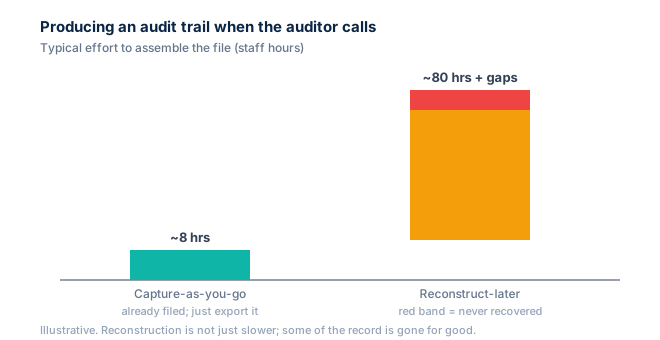
Capture-as-you-go and reconstruct-later are not two styles of the same task. They are different tasks. Capturing a decision the day it's made takes a couple of minutes and is accurate, because the people involved still remember the nuance. Reconstructing that same decision next year means interviewing people who've half-forgotten, cross-referencing emails that contradict each other, and guessing at the parts no one wrote down. It costs ten times the hours and produces a weaker record - and some of it you simply will not get back.
That's the trap: the cost of documentation doesn't disappear when you defer it. It grows. You always pay - the only choice is whether you pay a little now or a lot later, under pressure, with an auditor watching.
An audit trail you'll be glad you have, in seven habits
Decide what counts as an event. Approvals, scope changes, payments, sign-offs, key decisions. Name the handful of moments that must always leave a trace, so capturing them becomes reflex rather than a judgment call.
Capture at the moment, not at month-end. The record is most accurate the day it happens. A two-line note written now beats a perfect memo written from memory in March.
Write down the why, not just the what. 'Approved Option B' is a fact. 'Approved Option B because Option A missed the permit window' is a defensible decision. The reasoning is what an auditor - and your future self - actually needs.
Name things so a stranger can find them. A consistent convention - date, project, document type - means the file is findable by someone who wasn't there. If only the author can locate it, it isn't really filed.
Make it append-only. A trail you can quietly edit after the fact isn't a trail; it's a draft. Records gain their power from being added to, never silently rewritten.
Tie every dollar to its commitment. Match invoices to contracts and change orders as they arrive, not at year-end. A payment with no traceable approval behind it is the first thing an audit flags.
Let 'ready' be the resting state. If your records are current, an audit is an export, not an expedition. The goal isn't to survive the audit; it's to never have to prepare for one.
Start with the next decision, not the last year
You don't fix this by going back and reconstructing everything - that's the expensive trap you're trying to escape. You fix it forward. The next approval, the next change order, the next 'we decided to...' - capture that one properly, the day it happens. Do it again on the one after. Within a single project cycle, your forward record is airtight, and the old chaos matters less every week.
None of these habits is difficult. The discipline is doing them on the day, every day, when the work is busy and the audit is hypothetical - which is exactly when they cost almost nothing. An audit trail isn't something you build for the auditor. It's something you build for the version of you who, a year from now, gets asked a question and simply answers it.
The habits are simple; the payoff compounds quietly until the day someone asks 'can you show me?' - more field notes on the records that quietly run your projects break down how small disciplines become an organization that's never caught flat-footed.