One Chart: How Turnover Erases Project Memory

When the project manager who ran your biggest capital job for three years gives her notice, here's the real cost - the one that never shows up in the backfill budget: she is also the only copy of why half the decisions on that project were ever made.
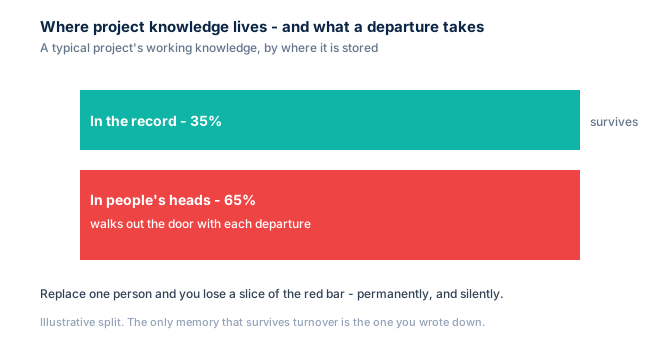
Picture a typical project's working knowledge as a single bar. Roughly a third of it is written down - in contracts, approvals, the document trail. The other two-thirds lives in people's heads: the reason a clause was negotiated the way it was, the verbal understanding with a subcontractor, the history behind a design change. The written third survives anything. The unwritten two-thirds walks out the door, a slice at a time, every time someone leaves.
The knowledge that has a pulse
Institutional memory feels permanent right up until it resigns. While the team is stable, nobody notices how much of 'how this project works' is undocumented, because the people who know are still in the room. You can just ask them. The whole operation runs on a kind of collective recall that feels like a system but is really a group of humans who happen to remember the same things.
Then someone retires, takes another job, or moves to a different department - and a chunk of that recall is simply gone. Not misfiled. Gone. The replacement inherits the title, the files, and the active to-do list, but not the context: the dozens of small 'oh, we did that because...' explanations that made the files make sense. They spend their first six months rediscovering decisions that were settled years ago, because the record captured the what but never the why.
What the chart is really saying
The number to sit with isn't the exact split - your projects may run more or less documented than the illustration. It's the shape of the risk: the part of your project memory that's exposed to turnover is almost always larger than the part that's protected, and you can't see the exposure until a departure makes it visible. By then it's too late to ask.
The fix isn't to document everything; that's neither possible nor useful. It's to move the highest-value knowledge - the reasoning behind decisions, the commitments behind dollars, the context behind changes - from the red bar to the teal one, while the people who hold it are still here. Every 'why' you capture is a slice of memory that no longer depends on anyone staying.
Treat every departure as a deadline
Tomorrow, look at your most critical project and ask who, if they left next month, would take irreplaceable context with them. That's not a retention problem; it's a documentation deadline. This is the quiet risk we built XNM-VISION to close - keeping a project's decisions and their reasons in one place that outlives any single person - but even without a system, the move is the same: write down the why before the who walks away.
Memory that lives in one person is a single point of failure with a salary and a calendar. More field notes on institutional knowledge and the records that outlast people trace what happens when the only copy gives notice.