The Permit Is Fast, the Obligations Are Forever: Why a Mine's Licence to Operate Lives in Its Record
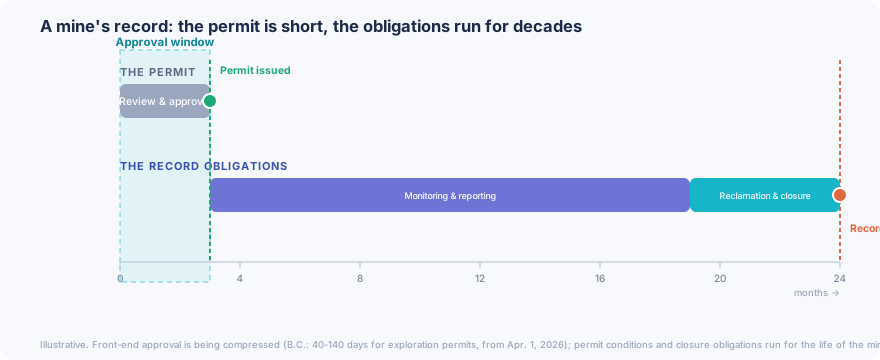
There is a quiet irony in Canada's push to speed up mining approvals. The reform energy is all aimed at the front end - shaving months off the time between an application and a yes. But the permit itself is the shortest chapter in a mine's life. What comes attached to that permit - the conditions, the monitoring obligations, the reporting deadlines, the consultation commitments, and the closure and reclamation duties - runs for decades, often outliving the mine plan that started it. A fast permit is a starting gun, not a finish line. And everything after the gun is a records discipline.
A producing mine carries a web of obligations that would be unrecognizable to anyone who thinks of a permit as a single document in a drawer. Water quality sampled on a schedule and reported to a regulator. Air, noise, and wildlife monitoring tied to specific permit conditions. Commitments made to a First Nation during consultation that have to be tracked and honoured year after year. Financial assurance for reclamation that has to be demonstrated and updated. Each of these is a promise the mine made to keep its licence to operate - social and regulatory alike - and each one is only as credible as the record that proves it was kept. When a regulator, an auditor, an investor's due-diligence team, or a community partner asks for evidence, 'we did that' is not an answer. The file is the answer.
Recent context
The acceleration is real and accelerating. British Columbia announced in early 2026 that, effective April 1, 2026, mineral exploration permits will be processed within 40 to 140 days depending on complexity, backed by $3 million in new investment and an escalation path that sends overdue applications to the chief permitting officer for a decision within 14 days. It follows a 35% increase in exploration permits issued in 2025 and a 35% reduction in major-mine application timelines through coordinated review - part of a national drive, with federal and provincial governments alike streamlining approvals for priority mineral projects.
Faster in does not mean lighter throughout
Compressing the approval window is good for projects and good for the country's critical-minerals ambitions. But it changes nothing about the obligations the permit imposes once granted - if anything, a faster front end means those conditions arrive sooner and run longer. The risk is a quiet mismatch: a permitting reform that optimizes the application while the years of compliance behind it are still run on spreadsheets, shared drives, and the memory of whoever wrote the original commitment. That is exactly where the licence to operate frays. A missed monitoring report, a consultation commitment no one can locate, a reclamation obligation that surfaces at closure with no clean record behind it - none of these are exotic failures. They are filing failures, and they cost permits, trust, and money. The mines that turn a fast approval into a durable operation are the ones that treat the conditions, from day one, as a record they will have to produce for decades.
How XNM helps
XNM helps mining companies put the whole compliance record into one auditable command centre - permit conditions and the obligations they create, monitoring schedules and the results filed against them, consultation commitments and how they were honoured, financial assurance, and the closure and reclamation file, organized by project and kept current. Where it helps, XNM-Vision turns a permit from a static document into a live obligation register, so a compliance lead can see at a glance what is due, what was filed, and what evidence stands behind each condition. When a regulator, an investor, or a community partner asks for proof, the complete chain is already assembled rather than reconstructed under deadline. The aim is not another drive to search; it is the single governed record that the operation, the regulator, and the closure plan all depend on - stood up in days, not the months a compliance-system project usually takes.
Practical takeaways
Turn every permit condition into a tracked obligation. A permit is not a document to file; it is a list of promises with deadlines - make each one a live item with an owner and a due date.
Keep the evidence with the obligation. A monitoring result, a consultation note, an assurance update - file it against the condition it proves, so the chain is ready before anyone asks.
Treat consultation commitments as permanent records. Promises made to a First Nation outlive the people who made them; the record is how the commitment survives staff turnover.
Build the closure file from day one. Reclamation obligations surface at the end but are earned across the whole life of the mine - a record assembled at closure is the weakest one possible.
Assume audit and due diligence, always. Regulators, investors, and partners will ask for proof; keep the compliance chain in a state where the answer is already there.
FAQ
Faster permitting reduces our burden, doesn't it?
It reduces the wait, not the work. A quicker yes gets you to operations sooner, but the obligations attached to that yes are unchanged - and they start sooner. The reform makes the front end lighter; it makes the records discipline behind the permit more important, not less, because compliance now begins earlier and runs just as long.
Isn't compliance the regulator's job to track?
The regulator checks; the obligation is yours to prove. When a condition is questioned years later, the burden is on the operator to produce the record that it was met - not on the regulator to find it. A governed obligation register is how you make sure that proof exists on the day it is demanded, not the day you start looking for it.
The bottom line
Canada can issue permits faster, and it should - the critical-minerals moment rewards speed. But speed at the front end only pays off if the obligations behind the permit are governed for the long haul. The licence to operate is not won at approval; it is kept, condition by condition, across the life of the mine. And it is kept in the record. A mine that can produce its chain on demand has a durable operation; one that cannot has a fast permit and a slow-building problem.