The Short Build Season, the Long Record: Why 750 Homes Across Nunavut Is a Records Discipline
In January 2026, three governments put their names to one of the most consequential housing commitments the North has seen: an agreement in principle to deliver up to 750 homes across Nunavut. The number is large, but the geography is what makes it hard. Those homes have to land in 25 communities with no road or rail connecting them, on a build season measured in weeks, with materials that arrive by sealift or air and a workforce that rotates in and out. A program like this is not one project; it is dozens of small, remote, weather-bound projects that have to add up to a coherent whole. And the only thing that holds dozens of remote projects together is the record.
For an Inuit government or a northern public agency, the housing file is the operating system of the whole effort: which community is getting how many units, which are modular and which built on site, the condition of what already exists, the repairs owed, the land and lot status, the procurement and contract trail, and - underneath all of it - who is actually housed and who is still waiting. When that information is spread across spreadsheets, a funder's portal, a contractor's email, and the memory of one housing officer, the program cannot be steered. Decisions get made on the freshest rumour instead of the current fact, and in a place where a missed sealift window costs a full year, that is not a clerical problem. It is the difference between a home this winter and a home the winter after next.
Recent context
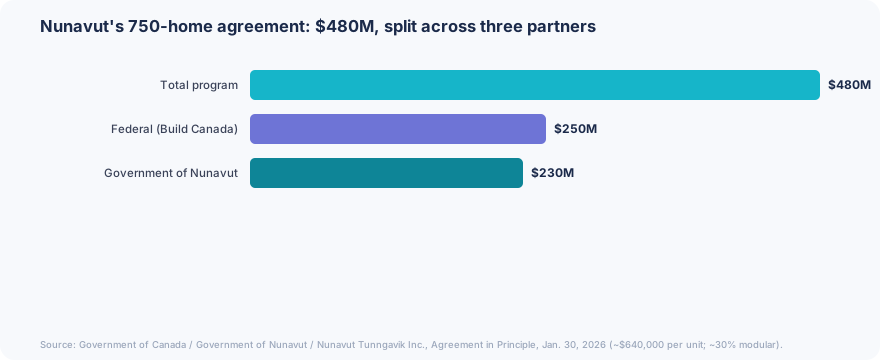
The commitment is concrete and already moving. Nunavut News reported on January 30, 2026, that the Government of Canada, the Government of Nunavut, and Nunavut Tunngavik Incorporated signed an agreement in principle worth $480 million - $250 million federal under the Build Canada Initiative and $230 million from the territory - to deliver up to 750 homes, at roughly $640,000 per unit, with about 30% built as factory modular units to work around the short construction season. Twenty-five of the units will be delivered and managed by NTI's Igluvut Corporation under an Inuit-led housing model, and the first modular homes are already going up in Baker Lake.
Distance turns a data gap into a year
Down south, an out-of-date record is an inconvenience; in the North it compounds with distance. Every fact about a home - is the lot serviced, did the windows arrive, is the furnace under warranty, was the unit handed over - is harder to verify and more expensive to get wrong, because the nearest person who knows may be a charter flight away. Layer on three partners who each need to report on the same dollars in their own format, and the reporting burden alone can swallow the capacity of a small housing team. The Inuit-led piece raises the stakes in the best way: a model like Igluvut's only delivers on self-determination if the data about Inuit housing is owned and governed by Inuit institutions, not scattered across other people's systems. Sovereignty over housing means sovereignty over the housing record.
How XNM helps
XNM helps northern governments and Inuit institutions pull the whole housing and infrastructure record into one auditable command centre - unit-by-unit status by community, condition and repair history, lot and land files, procurement and contracts, and the reporting each funder needs, tied together and kept current. Where it helps, the XNM-Vision platform gives a housing director a single line of sight across all 25 communities at once, so a sealift list or a winter repair plan is built on the live picture rather than last quarter's spreadsheet. When Canada, the territory, and NTI each ask for their report, the same governed record answers all three without a month of reconciliation. And because the system stands up in days, the visibility arrives in time for this building season - not the one after the data finally gets cleaned up.
Practical takeaways
Treat the housing record as program infrastructure. Seven hundred and fifty homes across 25 communities cannot be steered from scattered files; the record is the control system, not the paperwork.
Build the record to answer every funder at once. Three partners reporting on the same dollars should draw from one governed source, not three reconciled spreadsheets.
Tie condition and repairs to the unit, for life. A northern home's warranty, repairs, and handover should live with the unit - so the next housing officer inherits the history, not a mystery.
Plan logistics from the live picture. A missed sealift costs a year; build the season's material and modular list from the current record, not a stale one.
Keep the housing data under Inuit governance. Inuit-led housing means Inuit-owned housing data - sovereignty over the record is part of sovereignty over the program.
FAQ
We already report to our funders. Isn't that the record?
Funder reports are snapshots built for someone else's format; they age the moment they are filed. The record that runs a program is the living one underneath - unit status, condition, repairs, and decisions updating together - that every report is drawn from. Get that right and the reports become a by-product, not a quarterly scramble.
Is a single system realistic when each community is so different?
One record does not mean one-size-fits-all; it means one place where each community's distinct picture is current and comparable. A housing director still manages Baker Lake differently from Iqaluit - but they can see both, and the whole territory, without stitching together separate files first. The variation is the reason to centralize the record, not a reason to avoid it.
The bottom line
Four hundred and eighty million dollars and 750 homes is a generational commitment to the North - and in a place this remote, the record is what turns a commitment into homes people actually live in. The build season is short and unforgiving; the record is long and is what carries each unit from a line in an agreement to a key in a hand. Govern the record, and you govern the program.