Audit-Ready Should Be the Default, Not a Scramble

There are two kinds of organizations: the ones for whom an audit is a quiet afternoon of exporting files, and the ones for whom it's three weeks of panic, late nights, and a war room. The work they did was often identical. The difference is entirely in the state they keep their records in when nobody's looking.
We treat audit-readiness as an event - something you ramp up for when the letter arrives. That framing is the whole problem. The organizations that never scramble didn't get better at scrambling; they made 'ready' the resting state, so there's nothing to ramp. By the end of this you'll see why 'audit-ready' is cheaper as a habit than as an emergency - and not by a little.
The scramble is a tax on having deferred
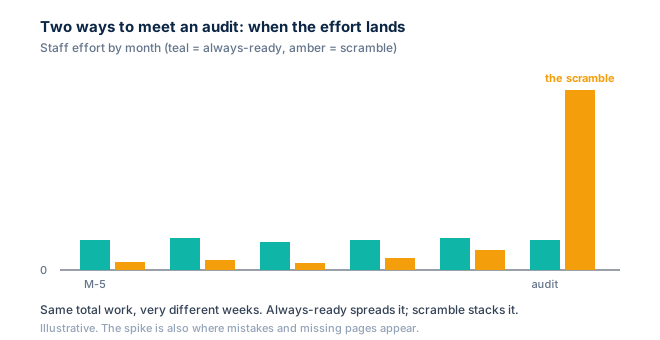
When an audit triggers a scramble, what you're actually watching is a year's worth of postponed documentation coming due all at once, with interest, on a deadline. Every 'we'll file it later' from the past twelve months lands in the same three weeks. People stop doing their real jobs to reconstruct a paper trail that should have written itself in real time. And because it's done under pressure, from memory, it's also the version most likely to contain errors and gaps - the exact things an auditor is trained to find.
The steady-state organization pays the same total cost, but spread across the year in small, calm increments - a record captured here, an invoice matched there. No spike. No war room. The audit, when it comes, is a query, not a quest.
Ready is a state, not a sprint
Making 'ready' the default is less about tooling and more about a decision: that the record is part of the work, not a chore that comes after it. A decision gets logged when it's made. A payment gets matched to its commitment when it arrives. A document gets named so a stranger could find it, the moment it's saved. None of these is hard. What's hard is doing them when the project is busy and the audit is hypothetical - which is exactly when they're cheapest.
The payoff isn't only surviving audits. An organization whose records are always current can answer a board question in minutes, onboard a new manager without losing the thread, and defend a decision years later without a frantic search. Audit-readiness is just the most visible benefit of a deeper discipline: knowing where everything is, all the time.
Make the boring choice, on an ordinary day
You won't feel the benefit on the day you make a record current; you'll feel it on the day someone asks for it and you simply hand it over. This is the steady state we built XNM-VISION to make normal - projects and records in one auditable place, so 'ready' isn't something you prepare for. But the principle stands on its own: do the small filing today, on the ordinary day, and the extraordinary day stops being a scramble.
The prepared don't move slower than everyone else - they move faster, because they never stop to hunt. More field notes on readiness, accountability, and the cost of the scramble show how 'always ready' quietly becomes a competitive advantage.