Field Notes: For First Nations, Records Are Sovereignty

When a consultant's contract ends, the laptop goes home with them. So, often, does the only complete record of the project they ran - the correspondence, the drawings, the approvals, the quiet institutional memory of why each decision was made. For a First Nations government, that departure is more than an inconvenience. It touches something larger: who holds the record, and therefore who holds the story.
Self-determination is usually discussed in the language of land, jurisdiction, and governance. But it also lives in something far more ordinary - a folder, a server, a filing system. A Nation that controls its own information controls its own evidence, its own narrative, and its own footing in the next negotiation. A Nation whose records live on an outside firm's drive is, in a practical sense, dependent on that firm to remember its own history.
The record as an act of self-determination
Across Indigenous governance, data and records are increasingly understood not as back-office paperwork but as an extension of sovereignty. First Nations in Canada have articulated this through a well-established set of principles known as OCAP - Ownership, Control, Access and Possession - developed and stewarded by the First Nations Information Governance Centre. In plain terms, OCAP asserts that a First Nation owns its community information and decides how that information is collected, used, shared, and stored. It reframes records from a technical question into a question of self-government.
Seen that way, a project's documentation is not just project hygiene. It is the difference between a Nation that can answer 'show us the agreement, the approval, the history' from its own files, and one that has to ask a former contractor to dig through theirs - if that contractor still has them, and still answers the phone.
Capacity you can keep
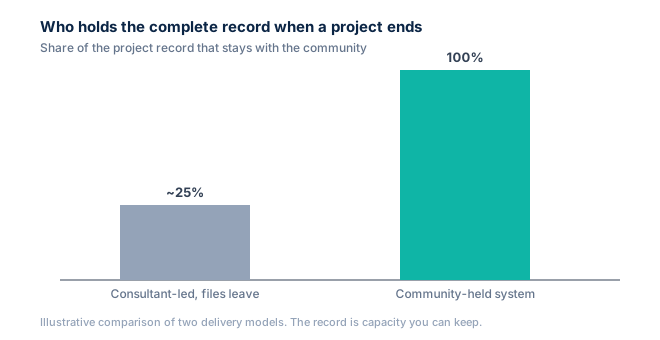
There is a version of capital-project delivery where an external firm arrives, runs everything, and leaves with the knowledge. The buildings remain; the know-how doesn't. There is another version where the Nation's own people and systems hold the record as the work proceeds - so that when the consultant moves on, the capacity stays behind. The first model rents expertise. The second builds it.
This isn't an argument against outside help; complex projects often need it. It's an argument about where the record lives while that help is engaged. A drawing set, a decision log, a contract file held in the Nation's own system is capacity that compounds - each project leaving the next one better equipped, instead of starting over from someone else's memory.
What this looks like on Monday
It looks unglamorous: a records system the Nation owns, naming conventions its own staff set, and a standing expectation that every consultant hands back a complete, organized file - not a parting gift, but a contractual default. None of that requires a treaty. It requires deciding that the record belongs at home. Sovereignty, in the end, is partly a filing decision - made over and over, on ordinary days, long before anyone asks to see the file.
The same principle - that whoever holds the record holds the power to answer for the project - runs through every sector we write about. More field notes on records, accountability, and who gets to tell the story follow the thread across communities and capital projects.