The Contract Two Teams Signed Differently

Two signatures sat at the bottom of what everyone called the same contract. The trouble was that they were not signing the same contract. One team had initialled a version dated the 12th. The other had signed a version dated the 14th - revised after a late phone call that one side documented and the other did not. For eleven weeks, a provincial agency and its contractor argued over a single clause, each holding a page that proved them right.
Nobody had committed fraud. Nobody had even been careless in the ordinary sense. Two competent teams, working in good faith, ended up bound to two slightly different documents - and the gap between them was worth real money. By the end of this, you'll see exactly where that gap opens, and why the contract you think you signed is rarely the only contract in the room.
Signing the same title is not signing the same document
A contract is not its title. 'Master Services Agreement - Final' is a name, not a guarantee. During negotiation, a document can pass back and forth a dozen times. Each pass spawns a new file: redlines accepted here, a payment term softened there, an indemnity clause that grew a sentence on Thursday and lost it on Friday. The version that finally gets signed is supposed to be the single document both parties have converged on. Often it isn't. One side prints the copy in their inbox; the other signs the copy on their drive; and those two copies are one revision apart.
The clause at the centre of this provincial dispute was a change-order approval threshold. One version said the contractor could proceed with changes under twenty-five thousand dollars and bill them. The other said any change required written approval first. Both numbers were real. Both had existed during the negotiation. Only one was supposed to survive - and nobody could prove which.
The drift happens before the ink, not after
We tend to imagine contract disputes as something that goes wrong later - a party acting in bad faith down the road. But version drift is born at the signing table, in the gap between 'we agreed to this' and 'this is the file we signed.' The riskiest moment in a contract's life is the handful of days when it exists as five near-identical attachments named v7, v7-final, v7-final-REAL, and Agreement(2).
Drift creeps in through ordinary human seams:
Email as the system of record. The 'latest' version is whichever inbox you happen to open, and inboxes disagree.
Last-minute verbal changes. A clause is adjusted on a call; one side updates the document, the other relies on memory.
Parallel editing. Two people revise two copies at once, and the copies are never reconciled into one.
Signing from a local download. Someone signs the file they saved last week, not the one finalized yesterday.
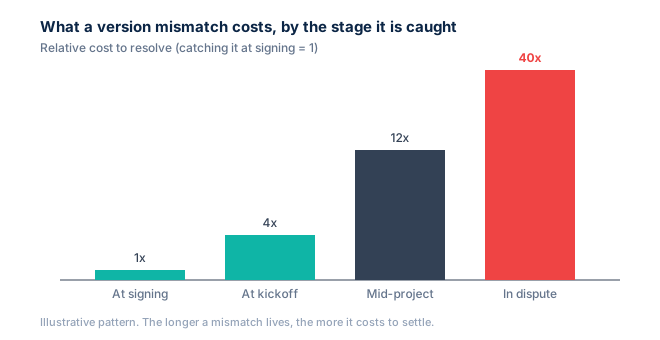
Make the executed version the single source of truth
The fix is not more lawyers; it's discipline about which document is the document. Before signature, both parties confirm they are signing the identical file - same version, same date, same locked copy. After signature, the executed copy lives in one place both sides can reach, not in two separate inboxes that will quietly diverge. This is the problem we built XNM-VISION to remove - one auditable home for the documents that govern a project, so the version everyone signed is the version everyone can find. But even without software, the rule stands: lock the executed copy, and store it once.
Tomorrow morning, look at your last three signed agreements and ask one question: if there were a dispute, could you prove - not assert, prove - that the other side signed the exact version you're holding? If the honest answer is 'probably,' you don't have a contract. You have two documents that happen to share a title.
This is the same failure we trace through change orders and approvals that vanish in the gap between a decision and the record - more field notes on the records that hold a project together show how small documentation gaps grow into expensive ones.