Why Speed and Compliance Aren't Opposites
The story everyone believes is that speed and compliance are enemies. You can move fast, or you can do it by the book - pick one. Cutting corners is how you hit the date; paperwork is the tax you pay to be safe. It's a tidy story, and on real projects it's backwards. The teams that move fastest are almost always the ones whose records are already in order. Compliance isn't the brake. Most of the time, it's the accelerator.
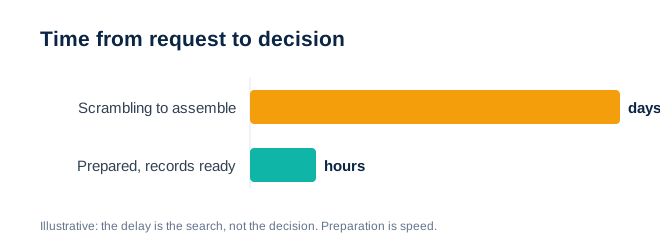
Watch where projects actually lose time and the myth falls apart. The delay is rarely the decision itself. It's the scramble before the decision - hunting for the current drawing, chasing the approval no one can find, reconstructing who signed off on what. A team that can produce the record in minutes decides in an afternoon. A team that has to assemble it first loses a week. Same decision. The difference is entirely the state of the records.
Why the prepared move faster
Speed on a complex project isn't about doing each task quickly. It's about not stalling between tasks - and stalls come from missing information. Every time work stops because someone is waiting on a document, an approval, or a version confirmation, that's not a compliance cost. That's a compliance gap, showing up as delay. The record you kept last month is what lets you say yes this month without a pause.
This is why the "fast versus safe" framing misleads. The genuinely fast teams aren't skipping the record - they're relying on it. When an inspector shows up, they don't stop work to prepare; the evidence is already there. When a client asks a hard question, they answer from a file instead of a meeting. Preparedness reads as speed from the outside, but it's really just the absence of scrambling.
When compliance actually does slow you down
To be fair, there's a version of compliance that is pure drag: duplicated forms, approvals that exist only to spread blame, reports no one reads. That's not compliance - it's ritual, and it deserves to be cut. The distinction is simple: real compliance produces a record someone will actually use to make a decision or prove a fact. Ritual produces paper that goes straight to a drawer. Keep the first. Kill the second.
The goal isn't more paperwork; it's the right record, captured once, where the next person can find it. Done well, that's not overhead at all - it's the thing that lets a team say yes quickly and mean it. A platform like XNM-VISION exists to make that capture automatic rather than heroic, but the deeper point stands on its own: an organization that can prove what it did is free to move faster than one that's always reconstructing its own past.
So the next time someone frames a choice as speed or compliance, push back. Ask where your last project actually lost its time. If the answer is "waiting on information we should have had," then compliance wasn't your enemy - the lack of it was. The prepared don't move slower. They move first.
The fastest teams aren't cutting corners - they're the ones who never lost the paper. more on how records turn into momentum.