When the Permit Goes Away, the Record Can't: Why Forestry Compliance Lives in the File

A forest company's most valuable asset is not the standing timber. It is the ability to prove, years after a block is logged and replanted, that every stem was cut under a valid authority, that the road was built and deactivated to plan, that the site was reforested to its obligation, and that the total harvest never ran past the limit the licence allowed. Cut the trees and the timber is gone; the record of how you cut them stays with the company for decades - and it is the record, not the trees, that a regulator, an auditor, or a lender comes back to.
Forest tenure is a bargain with the public: a licensee is granted the right to harvest a defined volume from public land in exchange for a dense set of obligations that outlive any single harvest. Cutting permits and road permits authorize the where and the how; cut-control accounting governs the how much over a multi-year period; silviculture obligations commit the licensee to reforest what it takes; and compliance-and-enforcement inspections test all of it against the record on file. Layer on stumpage returns, Indigenous consultation, and third-party certification, and a single block generates a paper trail that has to reconcile across agencies and survive long after the equipment leaves. When that record is spread across a permitting portal, a GIS layer, a silviculture contractor's files, and a woodlands manager's binders, compliance stops being a system and becomes a hope.
Recent context
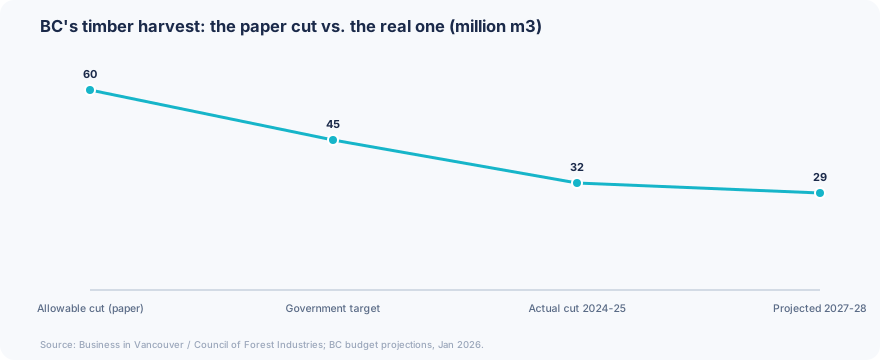
The ground is shifting under the paperwork itself. Business in Vancouver reported in January 2026 that British Columbia's harvest has run near 32 million cubic metres in 2024 and 2025 - barely half the 60-million-cubic-metre annual allowable cut on paper, and well short of the province's 45-million target - with the sector projected to fall toward 29 million by 2027-28. Amid mill closures and 15,000 lost jobs since 2022, the forests minister has said he wants to eliminate cutting permits altogether and move to 'operational planning forestry.' It is meant to speed approvals. But removing the permit does not remove the obligation - it shifts the burden of proof onto the licensee's own record.
Reform moves the paperwork; it does not retire the record
If the cutting permit disappears, the accountability behind it does not. A licensee still has to reforest what it harvests, still has to keep its multi-year cut within control limits, still has to build and retire roads to standard, and still has to satisfy inspectors and First Nations that what happened on the ground matches what was planned. In a permit-based system, the permit itself carried much of that evidence; in an operational-planning system, the licensee carries it. That makes the internal record more important, not less - and the industry is already carrying a heavy documentary load.
The load is well documented. A 2025 Forest Products Association of Canada report counts at least eight overlapping federal statutes and between 20 and 34 provincial laws that a forest operation must satisfy, with mills absorbing an estimated $46 million a year in reporting costs alone, and 49 mills closed and more than 8,700 jobs lost between 2013 and 2023 - failures it ties in part to regulatory delay and duplication. Its central recommendation is a 'one-window' record that federal and provincial reviewers both accept. Whether or not governments build that window, the licensee that already keeps a single, reconcilable record is the one that can answer any window that opens.
How XNM helps
XNM helps forestry licensees pull the tenure and compliance record into one auditable command centre - permits and their conditions, cut-control accounting, silviculture obligations and their completion, road tenure, stumpage and scaling records, inspection results, and the Indigenous consultation behind each block, organized by tenure and kept current. Where it helps, the XNM-Vision platform lets a woodlands manager show, on demand, that a given block was cut under authority, reforested to obligation, and kept within cut control - without reassembling the story from four systems after a demand for records arrives. As permitting reform shifts more of the burden of proof onto the licensee, that single governed record is what turns a compliance request from a scramble into a lookup. And it stands up in days, not the months a records project usually drags into.
Practical takeaways
Keep the obligation, not just the permit. Silviculture, cut control, and road standards outlive any authorization - track each obligation to completion so it survives whatever the permitting system becomes.
Reconcile cut control continuously. Volume limits run over multi-year periods; a record that reconciles as you go prevents the year-end surprise that a scattered one guarantees.
Assume the burden of proof is yours. As permits give way to operational planning, the evidence a permit once carried has to live in your own file - build it that way now, not after a demand letter.
Tie consultation to the block. Indigenous consultation and accommodation are part of the licence to operate; keep that record attached to the tenure it belongs to, not in a separate inbox.
Make one record answer every reviewer. Federal and provincial regulators, certifiers, and lenders all ask versions of the same question - a single reconcilable record answers all of them without a rebuild.
FAQ
If the province is removing cutting permits, doesn't that mean less paperwork for us?
Less permitting is not less accountability. The reforestation, cut-control, road, and consultation obligations remain; what changes is who holds the proof. Under permits, the authorization carried much of the evidence; under operational planning, your own record does. Companies that read reform as 'fewer files' rather than 'more responsibility for our files' are the ones a future audit will catch out.
We already keep good records in our GIS and permit system. Isn't that enough?
Spatial data and permit status are essential, but compliance turns on more than where and whether - it turns on the obligation behind each block, its completion, and the consultation and cut-control history tied to it. The gap that hurts is between 'the data exists in some system' and 'we can produce the whole reconciled story for this tenure today.' Closing that gap is the point.
The bottom line
Harvest half the allowable cut or all of it, the obligations run the same - for decades, and mostly in the record. As British Columbia rethinks how it authorizes logging, the one thing every version of the future has in common is that the licensee must be able to prove what it did. The companies that keep their tenure will be the ones whose record was never in doubt. In forestry, the trees are the product, but the file is the licence.