How to Document a Decision So It Survives the People
Two years from now, someone will stand in front of a choice your team is making this week and ask the only question that matters: why did we do it this way? By then the person who decided will have moved on - new job, new project, retired, forgotten. The decision will still be live. The reasoning behind it will be gone, unless you wrote it down. And most teams write down the what and lose the why.
There's a specific, small artifact that prevents this - and it's five lines long. Not a policy, not a system, not a meeting. Five lines, captured at the moment of decision. By the end you'll be able to write one in about ninety seconds.
The what survives on its own. The why evaporates.
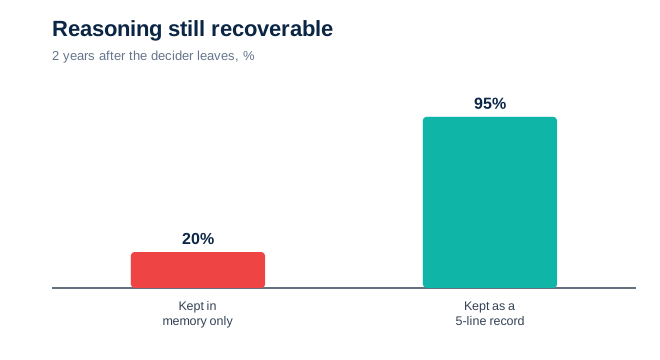
Look at how decisions actually get recorded. The outcome is easy - the drawing is revised, the vendor is selected, the change is made, the budget is moved. Those leave physical tracks. But the reasoning - the options you considered, the constraint that ruled one out, the risk you knowingly accepted, the person who signed off - lives only in the heads of the people who were in the room. Heads leave. And when they do, the outcome becomes an orphan: a decision no one can explain, which means a decision no one can defend, revisit, or safely reverse.
This is why teams re-litigate the same questions every eighteen months. Not because they're careless, but because the last answer arrived with no memory attached. Someone new looks at the arrangement, sees no rationale, assumes there wasn't one, and reopens it. The cost isn't just the rework. It's the slow erosion of trust in every past decision that can't explain itself.
The five-line decision record
You don't need a system to fix this. You need a habit and a template. When a decision is actually made - not proposed, made - capture these five things and drop them where the work lives:
The decision. One sentence, in plain words. 'We will use the precast option for the north foundations.'
The date and the decider. Who owns this, and when. This is the line that answers 'who approved this?' two years later.
Why - the one or two reasons that actually drove it. Not every factor. The deciding ones. 'Faster in winter conditions; avoids the crane conflict on the east side.'
What we ruled out, and why. The option you didn't take is the question someone will raise later. Answer it now. 'Cast-in-place rejected: schedule risk in freezing temperatures.'
What would change our mind. The condition under which this should be revisited. 'Revisit if precast lead time exceeds six weeks.'
That's it. Ninety seconds. The magic isn't in the format - it's in capturing the why at the exact moment it's still in someone's head, because that is the only moment it's cheap. A week later it costs a meeting. Two years later it's unrecoverable.
Write it for the stranger, not for yourself
The test of a good decision record is simple: could a competent person who wasn't in the room understand not just what you chose, but why, and when they'd be right to change it? Write for that stranger. They are the auditor, the new hire, the version of your own team that has forgotten - and they always arrive eventually.
You can keep these five lines anywhere the decision won't get separated from its reasoning - a note on the record, a field in your project tools, a line in the log. The point of a single system for projects and their records, which is the problem we built XNM-VISION around, is exactly this: the decision and its why stay attached forever. But even on paper, the five-line rule earns its keep. Tomorrow, write one for the biggest call your team makes this week.
A decision no one can explain is the same failure as an approval no one can find - the trail simply stops. more on the records that outlast the people who make them.