One Chart: How Long "Where Is It?" Actually Takes

Ask anyone on your team how much time they spend looking for documents, and they'll shrug: 'A few minutes here and there.' That shrug is the most expensive sentence in your organization. Because a few minutes here and there, multiplied by every person and every working day, quietly adds up to a full-time salary spent doing nothing but hunting for things that already exist.
The number that follows is illustrative, not a claim about your team specifically - but run your own version and the shape won't change. Let me show you how 'a few minutes' becomes a person you're paying to search.
The math nobody does
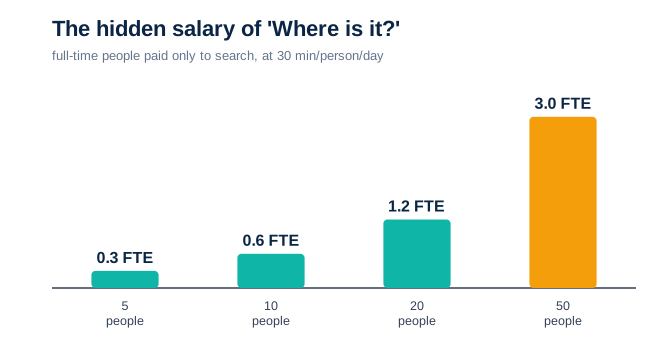
Start conservatively. Say each person loses thirty minutes a day to the search: the drawing that's three folders deep, the email with the approved spec, the latest version of the form, the number someone quoted last month. Thirty minutes is a low estimate - studies of knowledge work have long pegged document-hunting higher - but keep it conservative and it still lands hard.
Thirty minutes a day is two and a half hours a week. Call it roughly a hundred and twenty hours a year per person, once you take out vacation. On a team of twenty, that's about two thousand four hundred hours a year - the equivalent of more than one full-time person who does nothing, all year, but look for things. You're already paying that salary. You just can't see it, because it's smeared across everyone's day in five-minute smudges.
Why searching is worse than it looks
The hours are only the visible cost. Underneath them sit three more:
The interruption tax. A five-minute search isn't five minutes. It breaks concentration, and getting back into deep work costs far more than the search itself.
The wrong-version tax. Sometimes the hunt ends with the wrong document - an old revision, a superseded number - and the cost isn't lost time, it's a decision made on stale facts.
The give-up tax. Occasionally people stop looking and just recreate the thing. Now you have two versions of the truth, and tomorrow's search is worse.
That's the loop that makes this compound. Every failed or half-failed search makes the pile messier, which makes the next search longer. Disorder isn't static; it charges interest.
The fix isn't 'search faster'
You don't beat this by buying a better search box or telling people to be more organized. You beat it by removing the need to search - one authoritative place for each thing, so 'where is it?' has exactly one answer. The goal isn't finding documents quickly. It's never having to look, because there was only ever one place it could be.
Keeping a project and its records in a single place - which is precisely the problem XNM-VISION exists to solve - is one way to collapse that search time toward zero. But the first move costs nothing: this week, pick the ten documents your team hunts for most, give each exactly one home, and tell everyone where. Then watch how much of that invisible full-time salary you just got back.
The minutes lost to 'where is it?' are the same tax as the approval no one can find - disorder quietly billing you by the hour. more on the true cost of disorganized records.