The Record Is the Product

Here's an uncomfortable question for anyone who runs projects: what does your client actually pay for? You'll want to say the building, the road, the well, the connection - the physical thing. But walk it forward a year. The physical thing is standing there, doing its job, and nobody's looking at it. What they're asking you for, over and over, is the record: the certificate, the as-built, the inspection, the sign-off, the proof. For a surprising number of teams, the record isn't evidence of the product. It is the product.
This sounds like a semantic trick until you notice what it changes about how the work should be run. If the record is the deliverable, then treating it as cleanup - something you assemble at the end - is treating your actual product as an afterthought. By the end you'll see why the best teams have quietly inverted this.
Follow the thing that gets asked for
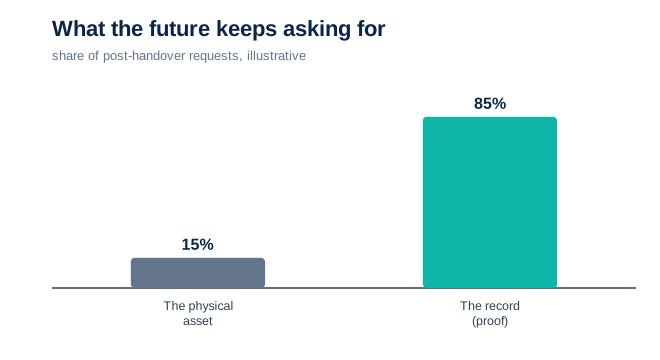
Think about what outlives a project. The crew demobilizes. The physical asset is handed over and, if it's good, becomes invisible - it just works. But the demands keep coming: the auditor wants the compliance file, the owner wants the warranty and maintenance records, the regulator wants proof of the conditions, the next contractor wants the as-builts, the lawyer - if it ever comes to that - wants the whole chain of who decided what and when. Every one of those requests is for a record, not for the physical thing. The record is what the future actually consumes.
In some sectors this is explicit. A large part of what an environmental, engineering, or compliance firm sells is literally a document - a report, a certification, a stamped drawing. The fieldwork exists to produce the paper. But even in sectors where you build something physical, the pattern holds underneath: the physical thing is delivered once; the record is delivered, and re-delivered, for years.
What changes when you believe it
Once you accept that the record is the product, a few things stop being negotiable:
Documentation isn't the last phase - it's the through-line. You don't 'do the docs' at the end. You produce the deliverable continuously, as the work happens, because that's when it's accurate and cheap.
Quality of the record is quality of the product. A messy, incomplete, unfindable record is a defective deliverable, even if the physical work is flawless.
The person who owns the record owns the product. It's not a junior task to tidy later. It's the thing you're actually being paid to hand over.
Teams that internalize this stop treating their document trail as overhead and start treating it as the asset it is. And it shows - in faster closeouts, cleaner audits, fewer 'can you resend that?' fire drills, and a reputation for being the firm whose paperwork is always right.
The mindset shift, in one line
You are not building a thing and documenting it. You are building a documented thing, and the documentation is the half your client keeps. The steel rusts, the crew scatters, the memory fades - the record is what's left holding your name.
This is the whole premise behind keeping projects and their records in one auditable place - the reason XNM-VISION exists is that the record and the work should never have been separate things. But you don't need software to make the shift. You need to stop calling it paperwork. Tomorrow, look at your current project and ask: if the record is what we're really delivering, are we building it, or are we planning to scramble for it at the end?
If the record is the product, then every lost approval and every missing condition isn't an admin slip - it's a defect in the thing you sell. more on why the record is the deliverable.