Field Notes: Accounting Firms and the Engagement File

Walk into any accounting firm the week before a practice inspection and you'll find the same quiet scramble: partners and managers pulling up old engagement files, checking not whether the work was done - it was - but whether the file can prove it. The work is rarely the problem. The evidence of the work is.
An audit or review engagement lives or dies on its file. Regulators inspecting firms don't re-perform the audit; they read what the firm wrote down. And the recurring message from those inspections, year after year, is remarkably consistent: the deficiencies are seldom about competence. They're about documentation - the reasoning that stayed in someone's head instead of going onto the page.
What inspections keep finding
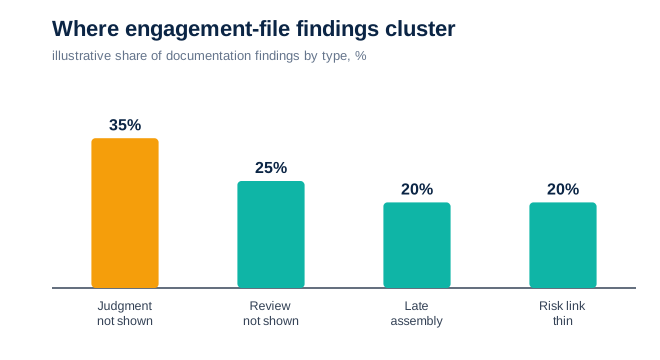
Across firms of every size, the findings tend to cluster in the same few places:
Insufficient evidence of professional judgment. The auditor made a sound call on a tricky estimate - but the file records the conclusion without the reasoning. An inspector can't see why the judgment was reasonable, only that one was made.
Review not evidenced. Work was reviewed by a senior; the file doesn't show it. Under professional standards, if the review isn't documented, it effectively didn't happen.
Timing and assembly. Documentation added or tidied after the report date, without a clear record of when and why. A file assembled late reads like a file reconstructed from memory - because it often is.
Thin support for risk assessment. The engagement identified risks, but the link between an identified risk and the specific procedure that addressed it isn't visible in the file.
The phrase that hangs over all of it is the oldest rule in the profession: if it isn't documented, it wasn't done. Not because inspectors are pedants, but because the file is the only thing that outlives the engagement. The team disperses, memories fade, and two years later the file is the audit.
The cost of these gaps is easy to underestimate because clients never see them. A file deficiency doesn't blow up in front of the audit client; it surfaces quietly, in an inspection report, a remediation plan, and hours of senior time spent re-documenting engagements that were, technically, done correctly. Multiply that across a busy season and the documentation habit stops being a compliance nicety and becomes a straightforward matter of capacity and cost.
The habit that prevents the scramble
The firms that sail through inspections aren't more talented. They document contemporaneously - the reasoning goes into the file as the judgment is made, not reconstructed the night before the file is due. They treat the sign-off as evidence, not a formality. And they assemble the file on time, so it reads as a record of what happened rather than a reenactment of it.
If your firm's inspection prep involves reopening files to add support, that's the tell. The problem isn't the inspection; it's that the file wasn't finished when the work was. Tomorrow, take one recent engagement and ask a colleague who wasn't on it to follow the reasoning using the file alone. Where they get lost is precisely where an inspector will.
The engagement file is the accounting profession's version of a universal rule - the record, not the work, is what gets tested. more field notes on the files that decide the outcome.