Trust at Scale Requires a Paper Trail

In a small organization, trust is personal. You know who promised what because you were in the room. The founder remembers every commitment; the whole team fits around one table. Then the organization grows - more people, more projects, more promises - and one day someone asks 'did we agree to that?' and the honest answer is a shrug. That shrug is the sound of trust outgrowing memory.
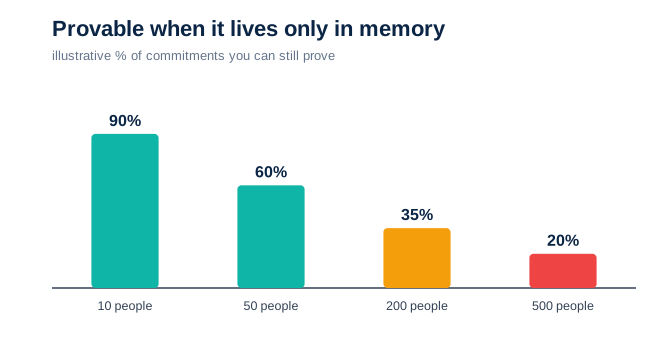
Every growing organization hits this wall. The relationships and recall that made it trustworthy at ten people quietly stop working at fifty. Not because anyone became less honest, but because no single mind can hold the commitments anymore. The thing that scales trust past that point isn't a stronger culture or a sharper memory. It's a paper trail.
Why memory doesn't scale
A promise you can't prove is a promise you're asking someone to take on faith. That works fine when the relationship is close and the stakes are low. As an organization grows, both change: the people making commitments aren't the ones keeping them, and the cost of a broken promise rises. A commitment made in a meeting and remembered by one person is one resignation away from vanishing. A commitment written down, with a date and an owner, survives turnover, handovers, and the passage of time.
This is the uncomfortable truth beneath a lot of what get called communication problems. They're often not communication problems at all - they're record problems. The information existed; it just lived in a head instead of a system, and the head moved on.
Consider what actually happens when a key person leaves. It isn't only their tasks that go; it's the unwritten context - the promise made to a partner over coffee, the exception granted to a client, the reason a decision was taken the way it was. If that context lived only in their memory, it leaves with them, and the organization is quietly less able to keep its word than it was the week before. Growth without a record is a slow erosion of accountability that nobody schedules and everybody eventually feels.
Building the trail without the bureaucracy
The instinct, hearing paper trail, is to recoil at bureaucracy. But the goal isn't to document everything; it's to make the commitments that matter provable - who agreed to what, when, and whether it was done. The lightest version is simply capturing decisions and promises where they can be found later, by someone who wasn't there. Done well, it feels less like red tape and more like a memory the whole organization shares.
This is ultimately what a records system is for. Tools like XNM-VISION exist not to add process for its own sake, but to hold an organization's commitments in a form that outlives any individual - so that trust rests on evidence, not on who happens to remember. The record becomes the institution's memory.
Tomorrow, think of one promise your organization has made that currently lives only in someone's head, and write it down where the right person could find it without asking. That single act is how trust starts to scale: not by remembering harder, but by needing to remember less.
An organization that can prove it keeps its word can grow without spending its reputation - that's the whole point of the record. more on the records test and what it reveals.