Building for 65 Million: Why an Airport's Capital Program Runs on Its Record

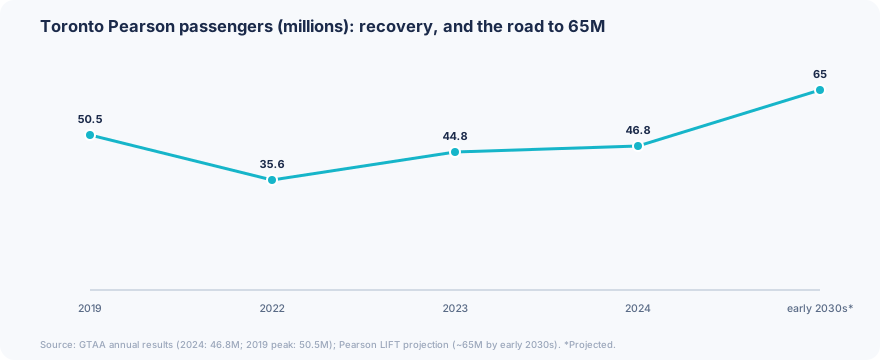
Toronto Pearson moved 46.8 million passengers in 2024 and is building for roughly 65 million a year by the early 2030s. To get there, the Greater Toronto Airports Authority has launched Pearson LIFT - Long-term Investments in Facilities and Terminals - a decade-long capital program whose first phase alone is worth about $3 billion and includes rebuilt runways, a new high-speed taxiway, more than 30 kilometres of baggage belts, and 20,000 smart airfield lights. The headline is the ambition. The quieter reality underneath it is that an airport authority cannot deliver - or defend - a program at that scale on anything less than a complete, current record of every asset, contract, and decision.
An airport is one of the most records-intensive enterprises a region owns. It is a landlord, a utility, a construction manager, a security operation, and a regulated aviation facility at once - and each of those roles generates its own paper trail. As-built drawings for hundreds of buildings and airfield structures, lease and concession agreements, environmental approvals, safety-management-system records, procurement files, change orders, and the board and regulatory decisions behind every capital dollar all have to line up. When those records live in separate departments, consultants' servers, and aging file shares, the airport does not so much lose the documents as lose the thread that connects them - and on a ten-year build, the thread is the program.
Recent context
The scale is not hypothetical. The GTAA reported that Toronto Pearson carried 46.8 million passengers in 2024, up 4.4 percent from 2023 but still short of its 2019 peak of 50.5 million - even as its own planning points to roughly 65 million a year by the early 2030s. Nationally, the federal government moved in the same direction, adding $5 billion through a new Trade Diversification Corridors Fund and boosting the Airports Capital Assistance Program by $55 million after 25 years largely unchanged. More capacity is coming; so is more scrutiny of how it is delivered.
The record is the program, not the paperwork
It is tempting to treat document control as back-office overhead on a project dominated by engineering and construction. On a multi-year capital program it is the opposite: the record is the mechanism that keeps a thousand moving parts coherent. Sequencing runway rehabilitation around live operations, proving to a regulator that a safety obligation was met, settling a contractor claim two years after a change order, closing out a phase so the next one can be financed - every one of these turns on producing the right document, in its current version, tied to the decision that authorized it. Airports also run on long-lived assets and long institutional timelines: the people who approved a design in year one may be gone by the time it is commissioned in year seven. If the reasoning lived only in their heads and their inboxes, the program inherits a gap exactly where it can least afford one.
How XNM helps
XNM helps an airport authority pull the capital-program record into one auditable command centre - as-builts and their revision history, leases and concessions, environmental and safety records, procurement files, contracts, change orders, and the board and regulatory decisions behind them, organized by project and kept current. Where it helps, the XNM-Vision platform gives a director of capital programs or an accountable executive a single line of sight across every phase, so a schedule, a regulator's request, or a contractor's claim meets a complete file rather than a search. And because it stands up in days rather than the many months a records overhaul usually takes, the visibility is in place before the next phase is committed - not reconstructed after a dispute or an audit forces the question.
Practical takeaways
Treat the capital record as program infrastructure. On a ten-year build, the document set is what keeps a thousand decisions coherent; an out-of-date record quietly misaligns schedule, cost, and compliance.
Tie every change order to the decision behind it. Claims surface years later; a change order that cannot be traced to its authorization is a settlement waiting to be lost.
Keep the regulatory and safety file audit-ready by default. Aviation oversight does not wait for you to assemble the record - keep it in a state where the answer is already there.
Preserve the reasoning, not just the drawing. The 'why' behind a year-one design has to survive to a year-seven commissioning, even after the people who decided it have moved on.
Give leadership one view across all phases. A board overseeing a multibillion-dollar program needs a single current picture, not a status binder refreshed once a quarter.
FAQ
We use experienced project managers and a document-control team. Isn't that enough?
Skilled people are necessary but not sufficient - they are also the single point of failure a long program cannot rely on. A document-control team protects the record only while its members and their conventions stay put; a governed system keeps the record authoritative across staff turnover, consultant handoffs, and the years between a decision and its consequences. The goal is to make the discipline structural rather than heroic.
Our program is already underway. Is it too late to fix the record?
No - and mid-program is often when the value is clearest, because the disputes, claims, and audits that test a record cluster in the back half of a build. Bringing the existing files into one current, auditable system now protects every phase still ahead and turns the messy first years into evidence rather than exposure. The sooner the record is straightened, the more of the program it protects.
The bottom line
Building for 65 million passengers is a governance story before it is a construction story. The airports that deliver programs like Pearson LIFT on time, on budget, and on the right side of a regulator are the ones that can see their own program - every asset, contract, and decision in one current, defensible record. Concrete and steel get the headlines, but the record is what holds a decade-long build together.