Give It or Account for It: Why a Foundation's New Disbursement Quota Is a Records Discipline

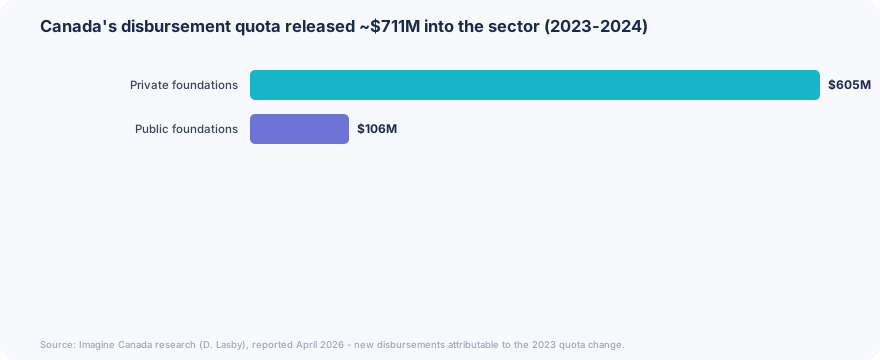
In 2023, Ottawa changed a single number and reshaped how Canada's foundations operate. The disbursement quota - the minimum share of assets a registered foundation must grant out each year - rose to 5 percent on holdings above $1 million, up from 3.5 percent. Imagine Canada's early analysis estimates the change released about $711 million in new charitable dollars over its first two years, roughly $605 million of it from private foundations. But the money is only half the story. The other half is that every foundation subject to the quota must now demonstrate, year after year, that it met the mark - and that demonstration lives or dies in the record.
A foundation looks, from the outside, like a simpler organization than the charities it funds. Inside, it runs on documentation: an investment portfolio and its returns, a stream of grant agreements each with its own conditions and reporting requirements, board minutes authorizing every disbursement, receipts and acknowledgements, and the annual T3010 filing that ties it all together for the Canada Revenue Agency. The disbursement quota sits on top of that as a mathematical test - assets valued, minimum computed, qualifying disbursements tallied. When grant records, board decisions, and asset valuations are scattered across spreadsheets, email threads, and a program officer's memory, meeting the quota becomes an annual scramble, and proving you met it becomes guesswork.
Recent context
The early data suggests the transition is not smooth. Imagine Canada's research, reported in April 2026, found that of roughly 1,190 foundations newly required to give more, more than half fell short of the new quota in the first year of reporting. About 80 percent did increase their disbursement rates, and the sector as a whole gave $104 million above the minimum - but that surplus was concentrated in a handful of large givers; strip them out, and disbursements would have fallen $133 million short. With a federal review of the quota anticipated in 2027, the pressure to both give and document is only rising.
Compliance is a records problem before it is a giving problem
The instinct is to read the shortfall as a reluctance to give. Some of it is; more of it is that many foundations simply cannot see their own position clearly enough to manage it. The quota is computed on last year's assets and this year's disbursements - a moving target that requires a current, connected view of what the endowment is worth and what has actually been granted and paid. A foundation that discovers in the spring that it undershot last year's quota has a records problem, not just a generosity problem: the information it needed to act arrived too late to act on. And because the CRA can review the T3010 and the supporting file, an undocumented disbursement is worth little even when the money genuinely moved. The dollars have to be given and shown.
How XNM helps
XNM helps a foundation pull its grantmaking and compliance record into one auditable command centre - grant agreements and their conditions, board approvals, disbursement and payment records, donor and asset documentation, and the figures behind the annual filing, connected and kept current. Where it helps, the XNM-Vision platform lets a foundation track its disbursement position against the quota through the year rather than discovering it after year-end, and produces the supporting record on demand when the CRA, an auditor, or the board asks. The aim is not another archive to search; it is a single governed view where the money given and the proof of giving live together - stood up in days, not the many months a records project usually takes.
Practical takeaways
Track the quota through the year, not after it. The disbursement test is a moving target; a foundation that measures its position through the year can act while it still can, instead of discovering a shortfall in the spring.
Tie every grant to its agreement and approval. A disbursement the CRA cannot trace to a board decision and a signed agreement is a compliance gap, even when the money genuinely moved.
Keep asset valuations and disbursements in one view. The quota is computed across both; when they live in separate spreadsheets, the number you file is an estimate rather than a fact.
Make the T3010 file audit-ready by default. The annual return is only as strong as the record behind it - keep the supporting file in a state where the answer is already there.
Preserve grantmaking memory across the board. Trustees and program officers turn over; the conditions, commitments, and reasoning behind multi-year grants must outlast the people who set them.
FAQ
Our accountant prepares the T3010 every year. Isn't compliance already handled?
The return is the output; the record is what makes it true. An accountant can only file what the foundation's documentation supports, and a shortfall or a gap discovered at filing time is discovered too late to fix for that year. The value is in seeing the disbursement position and its evidence throughout the year, so the filing confirms a result you already managed to rather than reporting one you can no longer change.
We're a small foundation with a simple portfolio. Does this really apply to us?
It applies wherever the quota does, and small foundations are often the most exposed - the same one or two people manage the investments, the grants, and the filing, so the record lives in their heads and their inboxes. A modest, governed system is what keeps a small foundation's compliance from depending entirely on one person being available and remembering everything. The simpler the team, the more the shared record matters.
The bottom line
The disbursement quota turned a foundation's generosity into a measured, documented obligation - give the minimum, and prove it, every year. The foundations that meet it comfortably will not be the ones with the most assets; they will be the ones that can see their own giving clearly and produce the record on demand. Under the new quota, a grant that cannot be shown is a grant that barely counts - and the record is how a foundation makes its giving hold up.