Field Notes: Indigenous Major Projects and the Readiness Gap

The proponent's team arrives with three banker's boxes of technical studies, legal counsel, and a schedule they'd like to keep. Across the table, a Nation's negotiators face a choice that was really made months earlier, in quieter rooms: do they have their own organized body of record - past agreements, community mandates, land and traditional-use studies, the full history of who said what to whom - or are they about to negotiate their own future from memory?
This isn't about goodwill, and it isn't about the strength of anyone's case. Both sides can be acting in complete good faith. It's about symmetry of information. The party that can find its own history quickly, cite its own prior decisions, and speak with one organized voice negotiates from strength. The party reconstructing its position in real time negotiates from behind. By the end you'll see why, on major projects, readiness has quietly become an advantage that arrives before the first meeting.
The readiness gap is really a records gap
A Nation carries deep and living knowledge - but that knowledge is often distributed across community members, past councils, consultants' reports, and filing cabinets holding agreements signed decades ago. When a major project lands, the question is rarely whether the knowledge exists. It's whether it can be assembled, verified, and spoken with authority inside the window the project moves in. That window is short, and it does not wait for anyone to go looking.
Why early is where the value lives
Most of the terms that end up mattering on a major project - the scope of consent, the shape of benefit and equity participation, the environmental conditions, the governance of the relationship itself - are effectively set in the earliest phases, long before any shovel breaks ground. Decisions made early, under time pressure and without organized records, are extremely hard to reopen later. A Nation that arrives with its history in order helps set those early terms. One that arrives still reconstructing is left reacting to terms already framed by someone else.
A single, controlled record of past agreements and their commitments - so no hard-won right gets quietly renegotiated
Land and traditional-use studies organized and accessible under the Nation's own governance
A clear, current community mandate, documented - so negotiators speak with real authority
A decision record that captures why past choices were made, for the leaders who come next
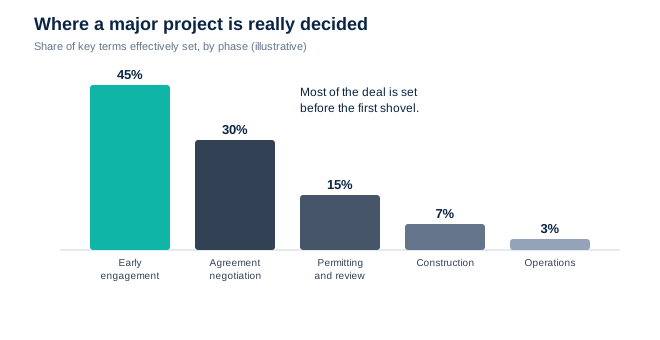
Read the chart plainly: the leverage isn't spread evenly across a project's life. It's front-loaded. By the time construction starts, most of what could be negotiated already has been. Arriving ready to the first conversations isn't a nicety - it's where the value is won or lost.
Readiness is self-determination, practically expressed
For a Nation, control of its own record is not administrative housekeeping. It is the practical form of self-determination: the ability to hold your own history, to govern who accesses it, and to bring it to the table on your own terms rather than depending on a proponent's version of events. The Nations moving with the most confidence on major projects are, quietly, the ones treating their records as an asset of governance - not a storage problem to deal with later.
What readiness looks like in practice
The common thread among Nations gaining the most from the current wave of major projects is unglamorous: they did the organizing work first, before a specific project forced the issue. Building capacity and putting the record in order between projects - not during them - is the difference between shaping a project and responding to one. Arriving early, with your own history in hand and under your own control, is an advantage that's hard to counter. It's already yours.
The same principle - that the organized party sets the terms - runs through every major project, in every sector we write about. We keep following how records quietly become leverageacross the field notes here. For a Nation, that leverage is also something more: it is history held, and told, on its own terms.