The Difference Between Busy and Accountable

Everyone in the status meeting is busy. The updates come around the table - calls made, emails sent, site visits done, late nights worked - and it all sounds like progress. Then someone asks a simple question: 'So are we on track, and can you show me?' And the room, so full of activity a moment ago, goes quiet.
There's a gap most organizations feel but never quite name: the gap between being busy and being accountable. From the inside they feel identical - both are exhausting, both fill the day, both leave you certain you earned your paycheck. But they produce completely different things. One produces motion. The other produces proof. By the end of this you'll be able to tell, in about four questions, which one your team is actually running on.
Busy is a feeling. Accountable is a record.
Busy is measured in effort - hours, activity, volume. It's real work and it matters, but it's invisible the moment it's done; you can't point to it later. Accountable is measured in evidence - a decision that got recorded, a commitment that was tracked to closure, a version everyone can still find. Busy answers 'what did you do today?' Accountable answers 'what can you prove next year?'
The trap is that busy feels like accountable in the moment. A team can work flat out, care deeply about the work, and still be completely unaccountable - because none of that effort left a trail anyone else can follow. And when the auditor, the board, the funder, or the lawyer finally arrives, effort counts for nothing. Only the record counts. The hardest-working team in the building can be the one that can't prove a single thing.
The four questions
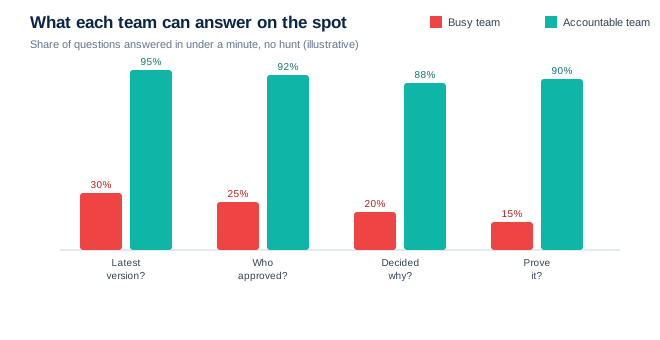
You can diagnose the difference fast. Ask a team these four questions and watch whether each answer is a confident document or an uncomfortable hunt:
Where's the latest version? - of the plan, the budget, the drawing. One clear answer, or three candidates and a shrug?
Who approved this, and when? - a name and a date, or a vague 'I think that got signed off somewhere'?
What did we decide, and why? - a recorded rationale, or a memory that's already blurring at the edges?
Can you prove it? - evidence on hand right now, or a promise to 'pull that together' by end of week?
A busy team scrambles on all four. An accountable team answers each in under a minute - not because they're smarter or work harder, but because the answers were captured as the work happened, instead of reconstructed after someone asked.
Motion isn't proof
This matters more every year, because organizations are increasingly judged not on how hard they worked but on what they can demonstrate. Grants require evidence. Audits require records. Public trust requires transparency. A capital project isn't accountable because the team is exhausted; it's accountable because anyone can trace what happened and why. Motion feels like accountability right up until the moment someone asks for proof - and then the difference between them is the whole game.
What to do tomorrow morning
Run the four questions on your most important project this week - not to catch anyone out, but to see honestly where effort is going in without evidence coming out. The goal isn't to work less or care less. It's to make sure the work leaves a trail behind it. Because at some point someone will ask you to prove it, and on that day, being busy won't help you. Being accountable will.
This is the shift we built XNM-VISION around - turning the daily motion of projects and records into a trail you can actually stand behind, in one place. But the four questions work with or without any software: if your team can answer them on the spot, you're already accountable, whatever tools you use to get there.
The line between motion and proof runs through nearly every story we tell here - the lost approval, the half-empty handover binder, the warranty clock nobody started. They're all the same failure wearing different clothesand you can follow the thread across the blog. Busy is optional. Accountable is a choice you make in how you keep the record.