The Environmental Condition That Slipped

The machines went quiet at 9:40 on a Tuesday, and for the first hour nobody on the cutblock knew why. There was no spill, no injury, no inspector at the gate. There was a sentence - one line, buried on page fourteen of a permit issued eight months earlier - that required a qualified professional to sign off on the stream crossing before any ground was disturbed within thirty metres of the creek. Nobody had signed off. Nobody, it turned out, had read that far.
The work stopped for nine days. Not because the forest was harmed - the crossing, once assessed, was fine - but because the operation could not prove it had met a condition it had agreed to in writing. By the end of this you'll see why the permit itself is almost never the problem. The conditions attached to it are.
A permit is a promise with fine print
When a regulator issues an approval, the headline is the yes. You can harvest, you can build the road, you can cross the creek. But that yes almost always arrives wrapped in conditions - do this monitoring, keep that buffer, file this report by that date, get a sign-off before this step. A modern forestry or resource permit can carry dozens of them. Each one is a small promise you've made to the Crown, to a First Nation, to a downstream neighbour, and each one has a clock or a trigger attached.
The dangerous thing about conditions is that they don't announce themselves. The permit gets read once - carefully - by the person who applied for it. Then it goes in a drawer, and the work begins. Six months later, a different crew, a different supervisor, a different season. The condition is still binding. The memory of it is gone. That gap between 'the permit is approved' and 'everyone doing the work knows what it requires' is exactly where operations get paused.
The conditions that actually catch people
In practice the conditions that stop work aren't the exotic ones. They're mundane, and they cluster:
Timing windows. No work in a watercourse during the fish window; no clearing during nesting season. Miss the calendar and a perfectly ordinary task becomes a violation.
Pre-condition sign-offs. A professional must inspect and approve before a specific step. The step happens; the sign-off never does; the record has a hole in it.
Monitoring and reporting deadlines. A report was due quarterly. Two quarters went by. Nothing bad happened on the ground - but the file can't show compliance.
Buffer and setback rules. A machine strayed inside a marked buffer for an afternoon. Small in reality, serious on paper.
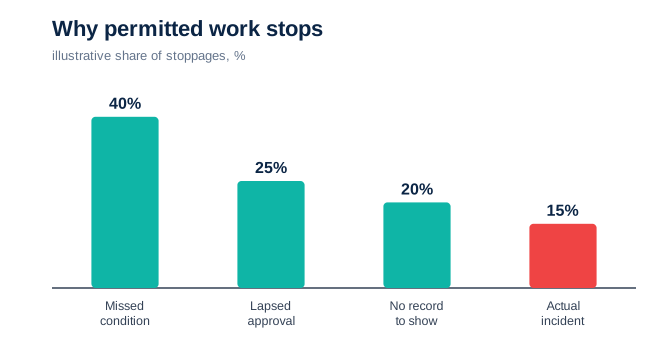
Notice what these have in common. In every case the environment was probably fine. The failure was the record - a condition that was live and a team that had lost track of it. That's a documentation problem wearing an environmental costume, and it's far more common than an actual spill.
The fix is a register, not a better memory
You don't close this gap by reading the permit harder. You close it by turning every condition into a tracked line item the day the approval lands. Pull each condition out of the document. Give it an owner, a trigger or a due date, and a place where its evidence of completion lives. A condition with no owner is a condition no one is watching.
Tomorrow morning, take your most active permit and do one thing: list its conditions on a single page - one row each, with who owns it and when it fires. Most teams have never seen their conditions in one view, and the exercise alone surfaces the two or three that are already overdue. The nine-day shutdown isn't caused by a hard rule. It's caused by an easy one that nobody was assigned to remember.
A missed permit condition is the same failure as a missing approval - a promise made in writing that the record can't prove you kept. more field notes on the records that decide compliance are here.