The Backlog in the Basement: Why School-District Renewal Is a Records Discipline

Somewhere in a school district's head office is a list no trustee likes to read: the renewal-needs backlog. It runs to thousands of line items - a failing boiler here, a roof at end of life there, an electrical panel that will not pass its next inspection - each attached to one of the dozens or hundreds of buildings the district is legally responsible for keeping safe and open. That list is not paperwork about the schools. For a facilities department, the list is the schools - the only complete picture of what the district owns and what condition it is in.
A school district is one of the largest property owners in its community, and among the oldest. Its buildings routinely outlast the careers of the people who maintain them; a school opened in the 1960s may be on its third generation of facilities staff. The record that describes each building - its age, its systems, the assessments done on it, and the capital work already approved - is the operating manual for the whole portfolio. When that record is scattered across a facilities database, a stack of consultants' condition reports, the province's capital-planning portal, and the memory of a superintendent of maintenance two years from retirement, renewal stops being a plan and becomes a guess.
Recent context
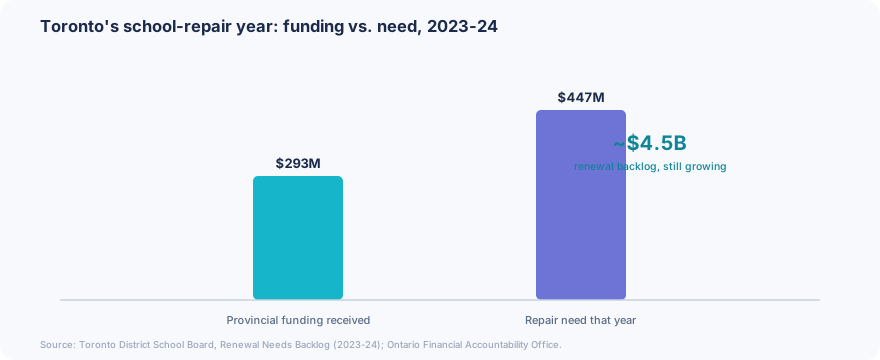
The scale is not hypothetical. The Toronto District School Board's Renewal Needs Backlog lists more than 20,000 repairs across 579 schools that average over 60 years of age, a backlog now estimated near $4.5 billion. In 2023-24 the board received $293.2 million in provincial maintenance funding but faced a repair need of roughly $447.1 million, so the backlog grew by about $70 million in a single year. Ontario's Financial Accountability Office has reported that 84% of the board's buildings sit below a state of good repair. Every one of those numbers is a roll-up of individual records - and a plan to spend against them is only as trustworthy as the record underneath.
Renewal is a prioritization problem before it is a funding problem
It is tempting to read a multi-billion-dollar backlog as a pure funding shortfall, and the shortfall is real - most boards get a fraction of what they ask for, with provinces funding a handful of a district's top priorities each year. But even fully funded, a renewal program collapses without a current, trustworthy record of what to fix first. British Columbia's Seismic Mitigation Program shows why. Since it began, the province has invested more than $1.9 billion upgrading high-risk schools, with risk assessed by Engineers and Geoscientists BC against a formal set of Seismic Retrofit Guidelines. When the 2015 National Building Code raised the assumed ground-motion intensity from the Cascadia fault, some schools that had already been mitigated returned to the priority list - not the whole building, but the specific sections earlier assessments had not covered. A district could act on that reassessment only if it knew, section by section, exactly what had already been done. That is not a construction capability. It is a records capability.
How XNM helps
XNM helps school districts pull the facilities and capital record into one auditable command centre - condition assessments, building systems and their ages, seismic and accessibility reports, the renewal-needs list, capital submissions to the province, contracts, change orders, and the board decisions behind each project, tied together and kept current. Where it helps, the XNM-Vision platform gives a secretary-treasurer or director of facilities a single line of sight across every school, so the capital submission is built on evidence rather than on whichever roof leaked most loudly this winter. When a trustee, a provincial reviewer, or an auditor asks why this school and why now, the answer is already assembled and defensible. And because it stands up in days rather than the many months a records overhaul usually takes, the visibility arrives in time to shape this year's capital plan, not the one after the next election.
Practical takeaways
Treat the renewal-needs list as the master record. It is the one document that reconciles every building, system, and dollar - keep it current and central, not rebuilt each budget season from scattered reports.
Keep condition data where the capital plan is built. Assessments only earn their cost if they drive the priority list; a report that lives in a consultant's PDF cannot prioritize anything.
Make the capital submission audit-ready by default. Provinces fund a fraction of what boards request; the districts that win are the ones whose case is documented, current, and easy to defend.
Track reassessments against what was already done. When codes or guidelines change, the question is which building sections were previously addressed - keep that history so a reassessment reshuffles the list, not the whole program.
Capture the maintenance knowledge before it retires. When a long-serving facilities lead leaves, the condition history of every school should stay with the district, not walk out the door.
FAQ
We already have a facilities condition database. Isn't that enough?
A database of components is a start, but renewal decisions need more than a component list - they need condition tied to cost, to the capital submission, to board approvals, and to the work already completed. The value is in a living record where an assessment, a funding decision, and a finished project update the same picture, so the plan reflects the district as it is now, not as it was at the last audit.
Isn't this really the province's funding problem, not ours?
Funding is part of it, but the part a district controls is how well it can see and defend its own needs. A strong, current record does not create money, but it makes the case that wins a larger share of what is available - and it makes sure the money you do get reaches the school that needs it most, not the one with the loudest advocate.
The bottom line
A renewal backlog measured in billions is a governance story before it is a construction story. The districts that manage it are the ones that can see their whole portfolio - every building, its condition, and the decisions shaping its future - in one current, defensible record. You cannot renew what you cannot see, and for a school district the record is how the board learns to see the schools it is responsible for.