Why Capital Projects Become Paperwork Projects by Month Six

For the first five months, a capital project is about building something. Drawings, mobilisation, weather, sequencing, the daily physical problem of turning money into a structure. Then somewhere in month six, without anyone announcing it, the project quietly becomes about proving you built it.
Nobody schedules that transition. It has no milestone and appears on no Gantt chart. But every experienced project manager recognises the moment: the week the meetings stop being about what happens next and start being about what happened, and whether you can show it.
The shift is arithmetic, not attitude
By month six a project has accumulated a past, and the past generates obligations the way the work generates dust. Progress claims must be substantiated. Change orders must be justified against a baseline nobody has looked at since spring. Deficiencies must be tracked, closed and evidenced. Somebody wants a monthly report, and somebody else wants a different monthly report with the same numbers arranged differently.
None of it is optional and none of it is waste. It is how a capital asset becomes a defensible one. But it is a different kind of work than the work everyone was hired to do, it arrives gradually, and it competes for the same hours.
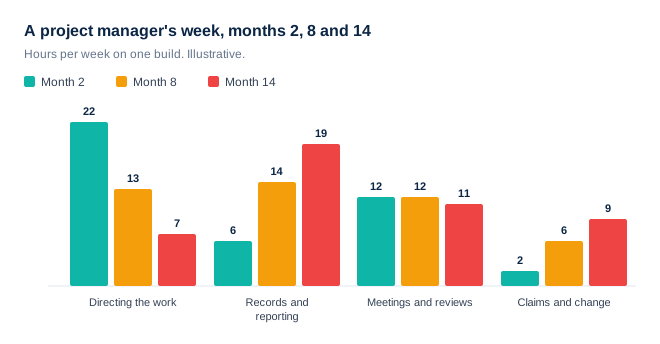
What the drift costs
Look at the first bar in each group. The hours a project manager spends actually directing the work fall by roughly two thirds across a single build, and every hour of that comes back as something else: reporting, reconstruction, claims. That is the real overrun mechanism on a great many projects. Not a bad estimate. Not a bad contractor. A slow migration of the most experienced person on the project from building to explaining.
The cruel part is that most of the explaining work is created by the earlier months. A decision recorded properly in month two takes eleven minutes. The same decision reconstructed in month fourteen takes half a day, involves three people, and produces a document that is weaker than the one you could have written at the time.
Getting ahead of it
You cannot prevent the shift; you can only decide whether it arrives as a surprise or as a plan. Three habits carry most of the weight, and all of them belong to the first five months, which is precisely why they get skipped.
Record decisions when they are cheap. One paragraph, at the moment, in the place the document lives. This is the highest-return habit in project work and it costs minutes.
Staff the proving half before you need it. Someone owning records and reporting from month one is not overhead. They are the reason your project manager is still managing the project in month fourteen.
Make the monthly report a by-product. If reporting is assembled from records that already exist, month six is a busy month. If it is assembled from memory and email, month six is where the project changes shape.
Every project you have ever worked on made this turn. The good ones simply saw it coming, and the difference showed up not in month six but in month twenty-four, when the file could answer for itself and nobody had to go looking.
This shift is the thread running through nearly everything in this series, from lapsed certificates to closeout binders to the audit nobody was ready for. If you want the rest of it, the field notes are all one argument told from different sites.