Many Projects, One Picture: Portfolio Oversight in a Provincial Capital Program

A provincial capital program arrives at the board table as a number. Underneath that number are dozens of concurrent projects at every stage - some in business-case development, some in procurement, some mid-construction, some in warranty - each with its own approvals, contracts, schedules, change orders and reporting obligations. The number is an aggregation of files. When the files are current, the number means something. When they are not, the number is a forecast dressed as a fact, and the board is governing on a picture assembled from whatever each project team had time to report.
This is the quiet failure mode of portfolio oversight in provincial agencies and Crown corporations. Nothing dramatic happens: a status report is compiled from twenty spreadsheets, a change order approved in March is reflected in a July dashboard, a project's risk is flagged verbally but never lands in a document anyone else can see. Then a single project slips or a cost jumps, and the questions arrive at once - when was this approved, who authorized the change, what did the last three status reports say, and why did the portfolio view not show it? By then the answer takes weeks of retrieval, and the delay itself becomes the story. The problem is rarely the absence of records; it is that they were never connected to the number they explain.
Recent context
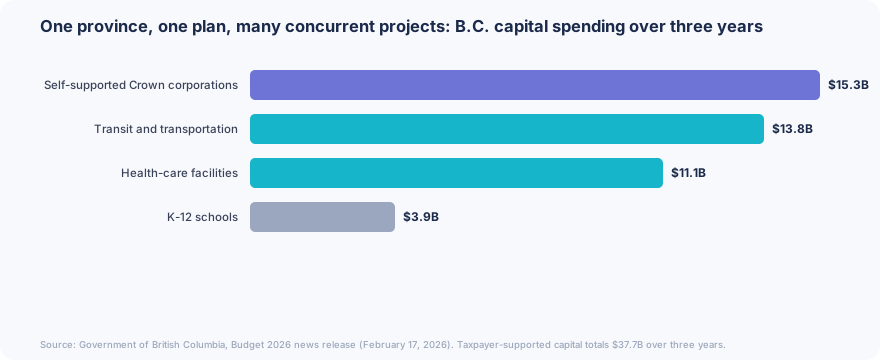
The portfolios keep getting bigger and more concurrent. British Columbia's Budget 2026 set out $37.7 billion in taxpayer-supported capital over three years - $13.8 billion for transit and transportation, $11.1 billion for health-care facilities, $3.9 billion for schools - covering 17 major hospitals and acute-care facilities and 66 K-12 school additions and improvements, plus $15.3 billion of self-supported capital in commercial Crown corporations, while explicitly repacing the plan and adjusting delivery timing on several approved projects. Quebec's Infrastructure Plan 2026-2036, announced in March 2026, runs to $167 billion over ten years, with $105.8 billion - 71 per cent - dedicated to maintaining existing assets, and reports 405 projects of $20 million or more completed between April 2019 and March 2026.
Repacing a plan is a records decision
When a government adjusts the timing of approved projects, as British Columbia did, the portfolio's paperwork has to move with it. Every deferral has an authorizing decision, a revised cost assumption, a contractual consequence and a stakeholder who was told something different last year. The same is true when a plan shifts toward maintaining existing assets rather than building new ones: asset-condition evidence, not ambition, becomes the justification for spending, and the condition record is what an auditor will test. A portfolio view that shows only status and dollars cannot answer any of that. A portfolio view anchored in the underlying files can, because the decision and its evidence sit in the same place.
How XNM helps
XNM helps provincial agencies and Crown corporations connect the portfolio view to the files beneath it - business cases and approvals, procurement records, contracts and change orders, status reporting, and the board and ministry decisions authorizing each stage, organized by project and rolled up across the portfolio. Where it helps, the XNM-Vision platform gives executives and boards one line of sight across every active project at once, so a variance in a dashboard can be opened down to the document that explains it, and an audit or legislative request meets a complete, time-stamped record. The aim is not another reporting cycle; it is a portfolio number an executive can stand behind because the evidence underneath it is one click away.
Practical takeaways
Make the portfolio number openable. Any figure at the board table should trace to the approvals and change orders that produced it, without a request to a project team.
Record deferrals as decisions. Repacing and rescheduling are governance choices; capture the authority, the rationale and the revised assumptions with the project they affect.
Treat asset-condition evidence as spending justification. When a plan tilts toward maintaining what exists, the condition record is what an auditor will test first.
Standardize what a project must report. Portfolios drift when each team reports differently; one definition of status, cost and risk is what makes a roll-up defensible.
FAQ
We already publish regular portfolio reporting. Is that not oversight?
Reporting tells you what teams say is happening. Oversight is being able to test it. The difference shows up the moment someone asks why a number changed: if the answer requires a round of emails to project managers, the reporting was a summary, not a record.
Our projects are delivered by different agencies and partners. Can one record really work?
It does not require one system for everyone. It requires the owner's own governed record of approvals, contracts, changes and reported status for each project, gathered in one place. Delivery can stay distributed; accountability cannot.
The bottom line
A capital portfolio is only as trustworthy as the files under it. Keep the approvals, contracts, changes and reporting connected to the number they explain, and oversight becomes a matter of looking rather than asking.