The Obligations Outlive the Approval: Tracking Benefit-Agreement Commitments Over a Project's Life

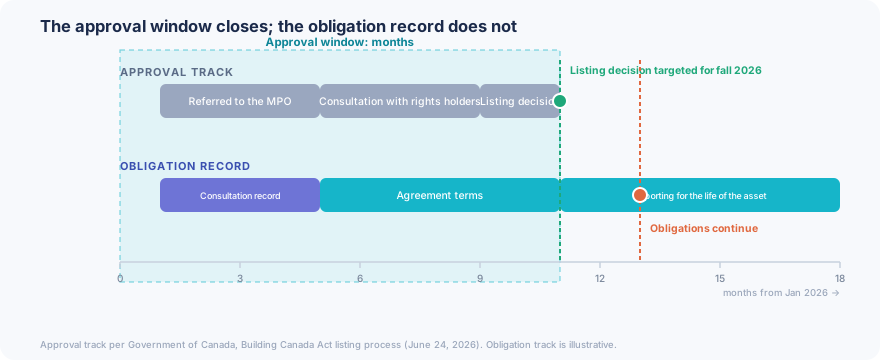
A joint venture between an industrial proponent and one or more First Nations is built on two very different clocks. The first is the approval clock: assessments, consultations, permits and a decision, all compressed into a window that regulators and financiers now push to close as quickly as possible. The second clock never really stops. A benefit agreement, an impact and benefit agreement, a consultation record or an equity arrangement commits both parties to obligations - employment and contracting targets, environmental monitoring, revenue sharing, reporting to a joint committee - that run for the operating life of the asset and often beyond it. Most of the effort in these partnerships goes into the first clock. Most of the risk sits on the second.
The reason is structural. During approvals, the file has an owner, a deadline and everyone's attention. Once the decision is made, that same file scatters: the consultation log stays with the regulatory team, the signed agreement with legal, the employment targets with human resources, the monitoring commitments with environment, the payments with finance, and the Nation's own copy in its own systems. Three years later, when a joint committee asks whether a contracting commitment was met in year two, the answer usually exists - it is just spread across four organizations and several people who have since moved on. That is not a compliance failure yet, but it is exactly how one begins, and it erodes something harder to rebuild than a spreadsheet: the confidence of the partner on the other side of the table.
Recent context
The scale of these partnerships is changing quickly. In June 2026 the Canada Indigenous Loan Guarantee Corporation backed a $700-million investment by the Williams Treaties First Nations in the Darlington New Nuclear Project, the largest Indigenous loan guarantee issued in Canada, supported by a roughly $715-million guarantee split evenly with the Province of Ontario through the Building Ontario Fund, under a $10-billion federal program. It follows a broader shift the Canada Energy Regulator tracked in February 2026: since 2021 Indigenous communities have acquired ownership interests in more than 5,000 kilometres of operating pipelines, alongside stakes such as the Haisla Nation's 50.1 per cent interest in Cedar LNG. Ownership on that scale turns a consultation file into a governance file.
Two clocks, one record
The practical problem is that the approval record and the obligation record are usually built as one thing and then treated as two. What a proponent files to obtain a decision - the consultation log, the accommodation commitments, the conditions accepted - is the same material that defines what both parties owe each other afterwards. When approval closes, that material should become the operating record of the relationship, indexed by commitment rather than by regulatory milestone: who committed to what, by when, measured how, reported to whom. Instead it usually gets archived. Rebuilding it later is possible but expensive, and it lands hardest on the partner with the least administrative capacity, which in many arrangements is the Nation itself. A shared, current record is not a courtesy in these partnerships; it is the mechanism through which a commitment made once stays visible to both sides for thirty years.
How XNM helps
XNM works as an author and partner to organizations on both sides of these arrangements, helping pull the obligation record into one auditable command centre - the consultation history, the signed agreement and its schedules, employment and contracting commitments, environmental monitoring obligations, revenue-sharing calculations, and the reporting that each commitment requires, indexed by obligation and kept current. Where it fits, the XNM-Vision platform gives a joint committee one view of what was promised, what is due and what has been evidenced, so a question at a quarterly meeting is answered from the record rather than from memory. XNM does not speak for a Nation or manage a partner's program; the contribution is governance and execution discipline applied to the documents, so both parties are reading from the same file.
Practical takeaways
Index the record by obligation, not by milestone. A benefit agreement is a list of commitments with owners and dates; a record organized around approval stages cannot answer the questions that come later.
Convert the consultation log into an operating record at closing. What was raised and how it was accommodated becomes the baseline for the relationship; archiving it is how the commitment quietly disappears.
Give both partners the same view. Where a Nation and a proponent read from different files, small discrepancies become disputes; a shared record is cheaper than a reconciliation.
Plan for the reporting horizon, not the approval horizon. Employment targets, monitoring and revenue sharing are reported for the life of the asset, long after the approval team has moved on.
Assume the people will change. Thirty-year obligations outlast careers; the record has to carry the context that would otherwise leave with a person.
FAQ
Our agreement already has a joint committee that meets quarterly. Isn't that the tracking mechanism?
A joint committee is the forum, not the record. It works well when both sides arrive with the same current picture of what was committed and what has been evidenced; it works poorly when each meeting starts by assembling that picture from separate systems. The committee is where the record is used - it is not a substitute for keeping one.
Much of this is commercially sensitive. Can a shared record work?
Shared does not mean open. These arrangements normally distinguish between what a joint committee sees, what each party holds privately and what is publicly reportable, and a record built for the relationship should carry those boundaries explicitly. The goal is that both parties can see the same commitments and evidence within the access rules the agreement itself sets.
The bottom line
The approval is the short part. What a consultation record and a benefit agreement create is a set of obligations that both parties carry for as long as the asset operates, and the quality of that partnership over decades depends on something unglamorous: whether the commitments made at the start are still legible, attributable and evidenced years later. Build the record for the longer clock.