One Building, Many Funders: The Record Behind a Community Housing Build

A community housing build looks like a single project from the street. On paper it is four or five projects layered on top of each other. A federal program contributes a forgivable loan or contribution. A provincial initiative adds capital on different terms. A municipality waives fees or puts in land or cash. A foundation funds a specific component. Sometimes a lender sits underneath all of it. Every one of those contributions comes with its own agreement, its own definition of eligible costs, its own conditions on affordability, tenancy or accessibility, and its own reporting cycle - and the non-profit in the middle has to satisfy all of them out of one set of invoices, drawings and decisions. That is the real complexity of community housing, and it is documentary rather than structural.
What makes it hard is not the volume of paperwork but the mapping. A single invoice may be eligible under one agreement, partially eligible under another and ineligible under a third. A construction change can affect an affordability commitment counted by two funders in different ways. A board decision to shift contingency has to be traceable in the record each funder reads. When an organization keeps this in a set of spreadsheets maintained by one finance lead - which is how most non-profits actually do it - the work is usually correct and almost never portable. It cannot be handed over, audited quickly, or reused on the next project, and if that person leaves mid-build the organization loses not just data but the logic connecting the data to five different agreements.
Recent context
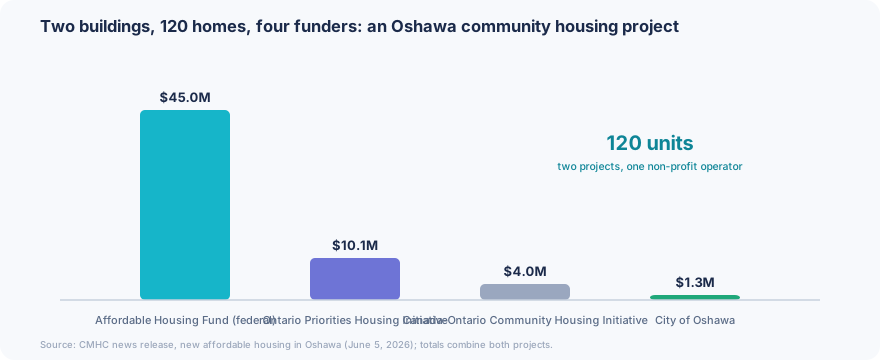
A recent project shows the shape of it plainly. In June 2026, Canada and Ontario announced more than $41 million for two Oshawa housing projects delivering 120 homes operated by Durham Region Non-Profit Housing Corporation. One project drew about $27.5 million from the federal Affordable Housing Fund, $4 million from the Canada-Ontario Community Housing Initiative and roughly $3.16 million from the Ontario Priorities Housing Initiative; the other combined $17.5 million from the Affordable Housing Fund, $6.9 million from the Ontario Priorities Housing Initiative, $1.34 million from the City of Oshawa and CMHC seed funding. One operator, two buildings, and at least four funding relationships to account to.
The stack is the risk
Layered funding is not a problem to be avoided; it is how community housing gets built in Canada, and a well-assembled stack is a sign of a capable organization. The risk is that the record is usually built for the construction, not for the stack. Project accounting tracks cost against budget. Grant management tracks a claim against an agreement. Very little tracks the relationship between them - which cost was claimed against which agreement, which condition it satisfies, and what happens to the other agreements if that cost moves. Because these projects run for years, the moment of maximum exposure is not the build; it is the annual reporting and the eventual compliance review, when a funder asks about a commitment made at the application stage and the person who made it has moved on. For an organization whose credibility with funders is its main asset, an inability to answer cleanly is a disproportionate cost.
How XNM helps
XNM helps non-profit housing providers and foundations pull the project record into one auditable command centre - each funding agreement and its conditions, the eligible-cost mapping, the construction and procurement file, board decisions, the affordability and tenancy commitments, and the claims and reports filed against each agreement, organized by project and kept current. Where it fits, the XNM-Vision platform lets an executive director and a board see all of a project's funder obligations in one place, so a claim, an annual report or a compliance question is answered from the record rather than rebuilt from a spreadsheet. The aim is not a bigger system for a small team; it is that the logic connecting one building to five agreements lives somewhere other than in one person's memory.
Practical takeaways
Map costs to agreements as you go, not at claim time. Deciding after the fact which invoice belongs to which funder is where errors and delays come from; capture the mapping when the cost is incurred.
Keep every funder's conditions in the project file. Affordability terms, tenancy rules and accessibility requirements are what compliance reviews test years later, and they rarely all live in one agreement.
Record board decisions that move money. Contingency shifts and scope changes affect several agreements at once; the decision and its rationale belong with the project, not only in the minutes.
Design the record to be handed over. A single finance lead holding the logic is the most common single point of failure in a small organization; make the mapping legible to someone else.
Treat reporting as an asset, not an obligation. Clean, timely reporting is what makes the next application credible with the same funders.
FAQ
Our funders each have their own portal and templates. Doesn't that already organize the work?
Each portal organizes its own relationship, which is exactly the problem: none of them can see the project as a whole. The organization is the only party that sees all the agreements at once, so the consolidated view has to exist on your side. Portals are where reporting is submitted; they are not where the project's record lives.
We are a small team with one build every few years. Is a formal record worth the effort?
The infrequency is the argument for it. When a project comes around every few years, no one is fluent in last time's requirements, and the knowledge from the previous build is exactly what would make this one cheaper. A record that survives between projects is worth more to a small organization than to a large one.
The bottom line
A community housing build is one set of walls answering to several agreements, and the organization in the middle is the only party that can see all of them. Keep the mapping between the building and its funders in one current, legible record, and the claims, the annual reports and the compliance review all draw from the same place - which is also what makes the next project easier to fund.