Campus Builds Run on Their Records: Capital and Research Infrastructure in a Tighter Decade

A university or college capital project has more than one master, and they do not share a rulebook. A new academic building answers to the institution's board, which approved the business case; to a provincial ministry, which holds the capital grant; often to a research funder, which paid for the equipment inside it; and to donors, whose gift agreements carry naming and reporting terms of their own. Each will eventually ask a version of the same question - what did we fund, and what did it deliver - and each expects the answer to be evidenced, not asserted.
That is where campus projects tend to strain. The design and construction file usually sits with facilities. The research equipment file sits with the research office, because it was applied for through a national program with its own eligibility rules and operating-fund conditions. The gift agreements sit with advancement. Board approvals sit in governance minutes. None of these is disorganized on its own, but together they are four partial records of one building, and none can answer a question that crosses two. When a ministry asks how a capital grant was spent, or a funder asks whether the infrastructure it financed is operating as proposed, the answer has to be assembled from pieces.
Recent context
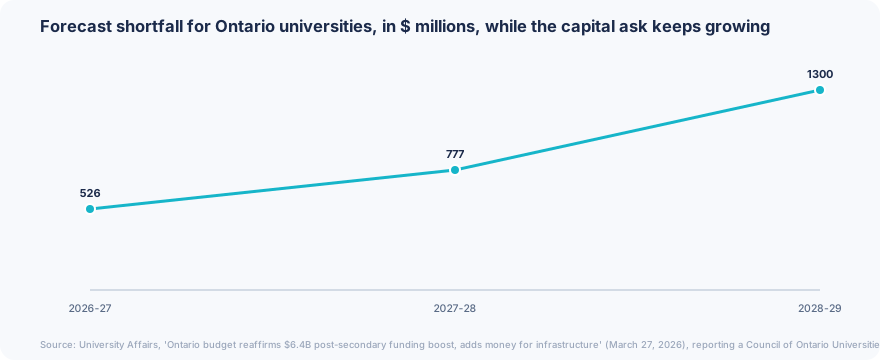
The funding picture makes the record more consequential, not less. University Affairs reported in March 2026 that Ontario's budget reaffirmed a $6.4-billion, four-year operating increase and added capital money: $202 million for university infrastructure in 2026-27, against $212 million the year before, with $1.48 billion over ten years for capital repairs, energy efficiency and technology, plus $117.1 million over three years through the Ontario Research Fund. The same coverage reported a Council of Ontario Universities forecast of a $526-million sector shortfall in 2026-27, widening to $777 million and then $1.3 billion by 2028-29. Institutions are asked to build while their operating room narrows.
Research infrastructure is a capital project with an extra rulebook
Research facilities carry conditions ordinary construction does not. The Canada Foundation for Innovation typically contributes up to 40 per cent of a project's cost, leaving institutions to secure the other 60 per cent from provincial, industry and other partners - so a single laboratory can rest on a stack of agreements, each with its own eligibility rules, matching requirements and reporting cycle. The awards are neither small nor rare: the CFI's Innovation Fund committed more than $552 million across 92 projects at 32 institutions in March 2026, and a May 2026 round through the John R. Evans Leaders Fund supported 25 Canada Research Chairs at 16 universities. Each has to show that the money bought what was proposed, that matching funds materialized, and that the facility operates as described - an obligation running years past the ribbon cutting.
How XNM helps
XNM helps institutions pull a campus project's record into one auditable place: the board-approved business case, the ministry capital grant and its conditions, the construction contract and its change orders, research infrastructure awards with their matching and operating-fund obligations, gift agreements, and the commissioning and occupancy record that closes the loop. Where it helps, the XNM-Vision platform lets facilities, the research office, advancement and the board work from one current picture instead of four partial ones. XNM brings the governance and execution discipline; the record and the decisions stay with the institution.
Practical takeaways
Treat the building as one file, not four. Facilities, research, advancement and governance each hold part of the same project; the answer to any real question crosses at least two.
Attach every funding condition to its evidence. Matching requirements, eligibility rules and operating-fund terms are testable years later, and only if the proof was kept beside them.
Carry gift agreement terms into the project record. Naming, recognition and reporting commitments are contractual, and they outlive the people who negotiated them.
Do not let commissioning be the last thing documented. Occupancy, equipment acceptance and operating readiness are what a research funder actually asks about.
Assume review, because the money invites it. Public capital grants and national research funds both come with the right to look; a ready file makes that routine.
FAQ
Facilities already runs a project management system. Why is that not enough?
Because it covers construction, and the later questions reach beyond it. A ministry asks about grant conditions; a research funder asks about matching contributions and operating funds; a board asks how the approved business case turned out. Those answers depend on documents that never lived in the construction system. The value is not replacing it - it is making the record around it complete and connected.
Our research infrastructure awards are administered centrally. Isn't the reporting handled?
The reporting is handled; the evidence behind it usually is not, in one place. Award conditions, matching confirmations, equipment procurement, installation and operating status sit with different offices. Reporting is easiest when it draws on one current record rather than a round of requests before every deadline.
The bottom line
Campus capital projects are judged twice: when they open, and repeatedly afterwards by the people who funded them. With operating pressure rising alongside capital ambition, the strongest position belongs to institutions whose record can show, without reassembly, what was approved, what it cost and what it delivered.