The Records Behind the Investment: Metis Governments and the Capital They Now Steward
A Metis government's development corporation has become, in plain terms, a capital allocator. It takes equity positions in energy and infrastructure, borrows against federal guarantees, builds and manages housing, and reports back to a citizen-elected government that answers to its members. That is a serious financial role, and it does not run on ambition alone. It runs on a record - the agreements, board resolutions, permits, contracts, draw requests and audited results that show what was decided, what it cost, and what it delivered.
The hard part is rarely the decision. It is the evidence. A single infrastructure investment can involve a federal contribution agreement, a provincial permit chain, a project company with its own governance, a lender that wants covenants tested on a schedule, an engineering consultant holding the drawings, and a Metis government whose citizens are entitled to know how their nation's money is being used. Each party keeps part of the story; none keeps the whole of it. So when a funder asks for the file, an auditor tests a claim, or a new board member asks why an option was chosen three years ago, the answer gets assembled from drives, inboxes and spreadsheets by the two or three people who happen to remember. That is not a governance system. It is a dependency.
Recent context
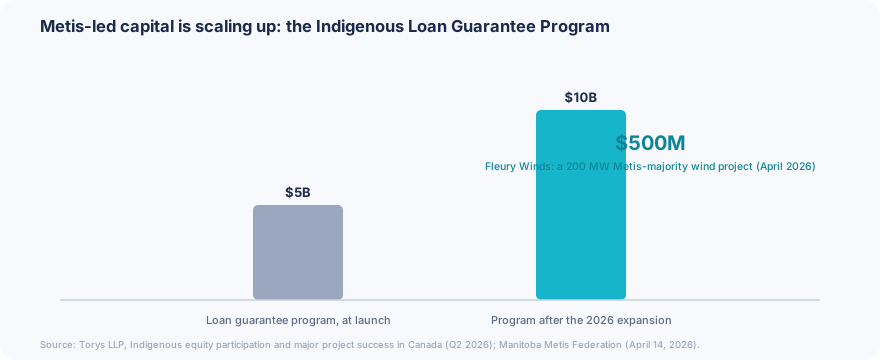
The scale of what Metis governments are stewarding has changed. In April 2026, the Manitoba Metis Federation and RES announced the planned Fleury Winds project - a 200-megawatt wind development near Neepawa, Manitoba, representing roughly $500 million of investment and majority-owned by the MMF and the Red River Metis Power Corporation. It is one project, but it is representative. The financing environment has moved with it: in its Q2 2026 review of Indigenous equity participation, Torys noted that the federal Indigenous Loan Guarantee Program has been doubled from $5 billion to $10 billion, and that the Major Projects Office's Indigenous Advisory Council includes Metis representation alongside First Nations, Inuit and modern-treaty governments. The direction of travel is clear: from grant recipient to owner.
Equity changes what the record has to prove
Grant funding asks a fairly narrow question - was the money spent on the eligible thing, and can you show it. Equity and debt ask harder ones. A lender wants the project agreements, the construction budget and its variances, the permits and their conditions, and the board authority behind every commitment, produced on a schedule rather than on request. The corporation's own board needs that same picture across every holding at once, because concentration risk is invisible when each investment is reported separately. And the Metis government behind the corporation carries a duty no lender imposes: its citizens are the ultimate owners, and the legitimacy of a decision rests on being able to explain it years later to people who were not in the room. That is why the record is not administrative overhead. It is the mechanism by which a nation's economic decisions stay accountable to the nation itself.
How XNM helps
XNM works with Metis governments and their development corporations as a partner and author - the mandate, the decisions and the delivery stay where they belong. What we help with is the record behind them: bringing contribution agreements, project agreements, permits, construction contracts and change orders, board and assembly resolutions, draw requests and funder reporting into one governed, auditable place, organized by project and kept current. Where it fits, the XNM-Vision platform gives a board and a finance team one line of sight across every project and investment at once, so a covenant test, a draw request or a citizen's question is answered from a complete, time-stamped file rather than from a reconstruction built under deadline.
Practical takeaways
Keep the owner's copy of every agreement. Consultants, project companies and lenders each hold a slice; the corporation needs its own complete set, because it is the party that answers for the investment.
Tie board authority to the commitment it authorized. A resolution that cannot be matched to the contract, draw or investment it approved is a governance gap waiting to be found.
Report across the portfolio, not one project at a time. Concentration, timing and covenant risk only become visible when every holding is looked at in one picture.
Treat funder reporting as evidence, not correspondence. Contribution agreements release money against conditions; keep the condition, the proof and the report together so a claim is never rebuilt from memory.
Write for the citizen who asks in five years. Legitimacy depends on being able to explain a decision to people who were not in the room, long after the people who made it have moved on.
FAQ
Our development corporation is separate from the government. Whose record is it?
Both, in different ways. The corporation holds the operating record - agreements, contracts, financials - and is accountable to its own board. The Metis government holds the mandate and answers to citizens for how the nation's assets are used. Problems arise when neither side can see the whole picture: the corporation reports results without the decision trail, or the government holds resolutions without the evidence of what followed. The fix is not merging the two roles; it is making sure the record connects them.
Most of our reporting obligations are already met. Why change anything?
Meeting an obligation and being able to evidence it on demand are different things. Most organizations can produce a report; fewer can produce, within a day, the approval, the contract, the change and the proof of completion behind a single line in it. As equity and debt replace grants, the questions get sharper and the deadlines get shorter. The point is not more reporting - it is that the file behind the reporting already exists.
The bottom line
Metis governments are becoming owners of the projects that shape their economies. Ownership is a governance win, and it comes with a governance obligation: the record has to be as strong as the investment. Build it while the deal is being done, and the lender, the auditor and the citizen all get the same answer.