Twenty Projects, One Picture: Portfolio Oversight for Developers and Owner-Operators

A developer or owner-operator running a dozen concurrent projects is not really managing twelve projects. They are managing one portfolio that happens to be delivered as twelve. Capital, credit capacity, trades, consultants, insurance and management attention are shared across all of them, and so is the risk. Yet almost every reporting habit in the industry runs the other way: each project has its own budget file, its own consultant set, its own schedule format and its own monthly update, and the portfolio picture is assembled by hand, late, from whatever the project teams sent.
That works until two projects move at once. A trade shortage on one site delays a second because it is the same subcontractor. A lender covenant tested against one asset is affected by a draw on another. An escalation clause signed in one contract is quietly repeated in four more. A permit condition accepted on one file sets an expectation the municipality applies to the next. None of these are visible from inside a single project report - they are only visible when the contracts, approvals, change orders and schedules across the portfolio can be looked at together. When they cannot, the organization is not managing portfolio risk; it is discovering it.
Recent context
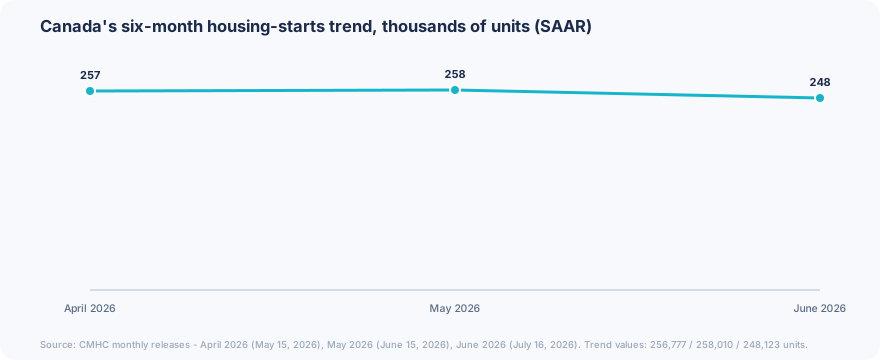
The market is currently a good illustration of why an aggregate number is not enough. CMHC reported on July 16, 2026 that the six-month trend in Canadian housing starts fell 2.8 per cent in June to 248,123 units, with the monthly seasonally adjusted annual rate down 6 per cent to 238,971. Year-to-date actual starts in centres of 10,000 or more were 113,017 units, about 1 per cent below the same period in 2025 - a broadly flat national picture. Underneath it, June starts were up 25 per cent year over year in Toronto and 10 per cent in Montreal, while Vancouver was down 35 per cent. A portfolio spread across those three markets would show almost nothing at the aggregate level and three completely different stories underneath.
Portfolio oversight is a records problem before it is a reporting problem
It is tempting to solve this with better dashboards. But a dashboard is only as good as the record beneath it, and the portfolio-level questions are almost all documentary. What did we actually commit to across these contracts? Which approvals are conditional, and on what? Where have we granted the same escalation or delay relief more than once? Which change orders are approved versus merely instructed? Which lender covenants are tested when, and what evidence supports the last certification? Answering those from a summary spreadsheet means trusting a transcription; answering them from the underlying documents means the answer holds. The organizations that manage portfolios well tend to have one common structure across projects - the same folders, the same document types, the same approval trail - so a question can be asked once and answered across everything, rather than asked twelve times and reconciled.
How XNM helps
XNM helps developers and owner-operators bring the record for every project into one governed, auditable structure - land and permit documents, consultant and construction contracts, change orders and approvals, lender and investor reporting, and the decisions behind each, organized the same way on every project so the portfolio can actually be read. Where it fits, the XNM-Vision platform gives principals and asset managers one line of sight across all active projects at once, with a server-side audit trail of who changed or approved what, so a covenant certification, an investor question or a claim on one site is answered from a complete, time-stamped record rather than a round of emails to project managers. The aim is not more reporting from site teams; it is one consistent record they are already producing, made visible at the portfolio level.
Practical takeaways
Standardize the structure before you standardize the report. A portfolio view is only reliable when every project files the same document types in the same places; consistency at the source removes most of the reconciliation.
Track commitments across contracts, not within them. Escalation, delay relief and indemnities repeat across agreements; the exposure is the sum, and the sum is invisible one contract at a time.
Separate approved from instructed. Work that has been directed but not formally approved is the most common source of end-of-project disputes and the easiest to miss at the portfolio level.
Tie lender and investor reporting to its evidence. A certification is only as strong as the documents behind it; keep the covenant, the test and the proof together on each asset.
Watch shared resources, not just shared capital. The same subcontractor, consultant or inspector across several sites is a correlation the financial reporting will never show you.
FAQ
We already use project management software on every project. Is that not portfolio oversight?
Project management software is built to run a project, and it does that well. Portfolio oversight asks different questions - about commitments, approvals and exposures that cross projects - and those usually live in contracts, correspondence and approvals rather than in schedules and tasks. The gap is rarely the tooling on any one site; it is that nothing reads across the sites in one governed record.
Our projects are at different stages. Does a single structure really work?
It works better than the alternative, because stage-specific detail can sit inside a common frame. Early-stage projects will have land, zoning and pro forma documents where a project in construction has change orders and progress claims, but the categories and the approval trail can be identical. That is what makes it possible to compare, and to move a project from one stage to the next without rebuilding its file.
The bottom line
A calm national number and a calm portfolio are not the same thing, and neither guarantees the other. The exposures that matter cross projects, and they live in contracts and approvals rather than in summaries. Build one consistent record across every project and the portfolio view stops being an assembly job.