Whose System Holds the File? Inuit Governments and the Arctic Build

In late June, the Prime Minister and the President of Inuit Tapiriit Kanatami co-chaired a meeting of the Inuit-Crown Partnership Committee in Kuujjuaq, joined by elected leadership from all four Inuit regions. On the table was a federal commitment described as a comprehensive plan of more than $40 billion to defend, build and transform Canada's Northern and Arctic region, with the Major Projects Office advancing dual-use infrastructure including the Grays Bay Road and Port and the Mackenzie Valley Highway. For Inuit organizations, the significance is not only the dollar figure. It is the seat at the table - and what a seat requires in order to be worth having.
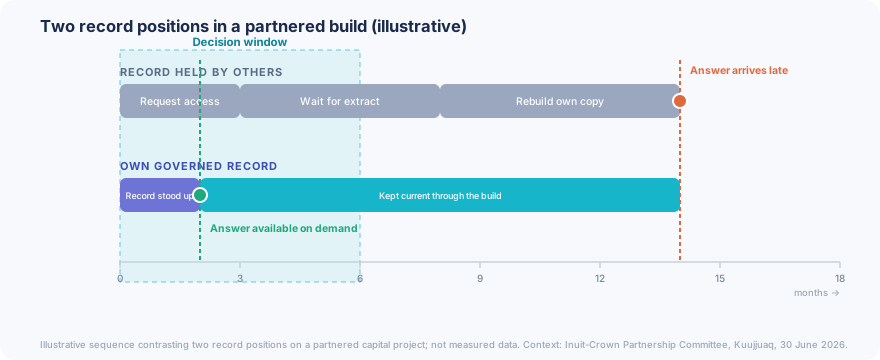
Being a partner rather than an applicant changes what an organization needs from its own records. An applicant fills in forms and reports upward against conditions someone else wrote. A partner is expected to hold positions, approve changes, hold others to commitments, and answer for decisions decades later. On a partnered megaproject the file is distributed by nature - across federal departments, proponents, engineering firms, contractors and the Inuit organization itself. Everyone holds a portion. The question that quietly determines how much influence an Inuit government actually exercises over a thirty-year asset is administrative rather than political: whose system holds the authoritative record, and can the Inuit party produce its own complete copy without asking anyone's permission?
Recent context
The scale is now on the record. The Prime Minister's Office reported on 30 June 2026 that the Inuit-Crown Partnership Committee met in Kuujjuaq with leadership from the Inuvialuit Regional Corporation, Nunavut Tunngavik Incorporated, Makivvik and the Nunatsiavut Government, and that the federal government had announced a comprehensive plan of more than $40 billion to defend, build and transform Canada's Northern and Arctic region. The Major Projects Office is advancing dual-use infrastructure including the Grays Bay Road and Port and the Mackenzie Valley Highway, while leaders prioritized housing and food security through Inuit-led solutions and committed to implementing the Inuit Nunangat Housing Strategy. These are multi-decade assets in territory where Inuit organizations are rights-holders, landowners and co-decision-makers at once.
Access is not the same as possession
It is easy to mistake a login for control. A proponent offers the community a seat in its project portal; a department shares a folder; a consultant promises the drawings at closeout. All of that is access, and access is genuinely useful. But access is granted by someone, on their terms, in their system, for as long as they choose to maintain it - and every one of those parties is temporary. Consultants demobilize at substantial completion. Contractors dissolve project entities. Departments reorganize and rename programs. Proponents are acquired. The Inuit organization is the only party still standing in year twenty-five, when a maintenance dispute, a benefit-agreement obligation, a regulatory question or a successor project turns on what was actually agreed and built. That is what record sovereignty means in practice: not a philosophical claim about data, but the concrete ability to open your own complete, current file without depending on an institution that may no longer exist. If your copy of the record can be switched off by someone else's decision, it was never really your record.
How XNM helps
XNM works with Indigenous governments and development corporations - First Nations, Inuit and Metis - that are moving from participants to partners on capital projects. The practical work is to make sure the organization's own copy of the record is complete, current and under its own control: agreements and their amendments, drawings and revisions, permits and approvals, change orders, correspondence that creates obligations, and the council or board decisions behind them, organized by project rather than by whoever happened to send them. Where it fits, XNM-Vision is the command centre that holds it, with the access controls that let an organization share what it chooses while keeping the authoritative copy on its own side of the table. XNM brings the governance and execution discipline alongside it, so that a partner shows up to the table able to answer as quickly as the parties across it.
Practical takeaways
Negotiate the record into the agreement, not after it. Data and document provisions are far cheaper to secure while a proponent still wants your signature than to request once the project is underway.
Ask for deliverables in a form you can keep. Native files and structured exports outlive a portal login; a viewing seat in someone else's system is not an archive.
Hold your own copy in parallel from day one. Reconstructing a record after the fact is expensive and incomplete - keeping pace as it is created costs almost nothing by comparison.
Organize by project and obligation, not by sender. The question in year twenty-five will be what was agreed and built, not who emailed it - file it so the answer is findable by the question you will actually be asked.
Plan for the other parties to disappear. Consultants demobilize, contractors dissolve and departments reorganize; assume every external system is temporary and your own is the one that has to last.
FAQ
The proponent has given us access to their project system. Isn't that enough?
It is useful, and it is not the same thing. Access depends on another organization continuing to grant it, maintain the system, and stay in existence - and it typically ends at closeout, which is precisely when the decades-long part of your obligation begins. Keeping your own copy in parallel is not a statement of distrust; it is ordinary prudence for the party that will still be answering questions long after everyone else has moved on.
We are a small organization with a lot of files already. Where does this realistically start?
It starts with the live project and the agreements that bind it, not with the archive. Get the current build's record organized and kept current from today forward, and bring historical material in as capacity allows. The compounding value comes from never again falling behind on something active - the backlog is a project, but the discipline is a habit, and the habit is the part that pays.
The bottom line
More than $40 billion of Northern and Arctic infrastructure will be planned, built and argued about over the coming decades, and Inuit organizations are at the table for it as partners. Influence at that table is exercised through positions, approvals and obligations - and every one of those lives or dies on whether the organization can produce the record behind it. The parties across the table will change. The record is what lets an Inuit government still speak with authority when they have.