The Decision No One Could Reconstruct
The question took four minutes to ask and five weeks to fail to answer. Who approved the change to the foundation detail, and what did they know when they approved it?
Fourteen months had passed. The building was finished and occupied. Now there was a claim, and a lawyer on the other side of it wanted a straight answer to a simple question. The project team went looking. What stopped them wasn't a shortage of documents — there were tens of thousands. Something else was missing, and it took five weeks to work out what.
Everything was there. None of it was connected.
The email thread existed. So did the meeting invite, the revised drawing, the invoice that followed, and a photo of the pour. Each artifact proved a fragment. The email proved someone raised it. The drawing proved something changed. The invoice proved money moved. Not one of them proved a decision — who made it, on what authority, with what in front of them.
A team can hold thousands of records and still be unable to answer a single question about any of them. That is the failure mode nobody budgets for, because it doesn't look like a failure until the day it does.
A decision is four facts. Most projects capture one.
Strip away the paperwork and every consequential decision on a project comes down to four things:
What was decided. The change itself, stated plainly enough that a stranger could repeat it back.
Who decided it. A named person who actually held the authority — not a group, not an inbox, not “the team”.
What they knew at the time. The drawing revision, the cost estimate, the constraint. Judged on what was on the table then, not on what everyone learned later.
What it changed downstream. The schedule, the budget, the other trades — the consequences that make a decision worth tracing at all.
Most projects capture the first one automatically, because the change lives in the work itself. The other three survive only if somebody made a point of keeping them together. Usually nobody did — not through negligence, but because on the day, the decision felt too obvious to write down.
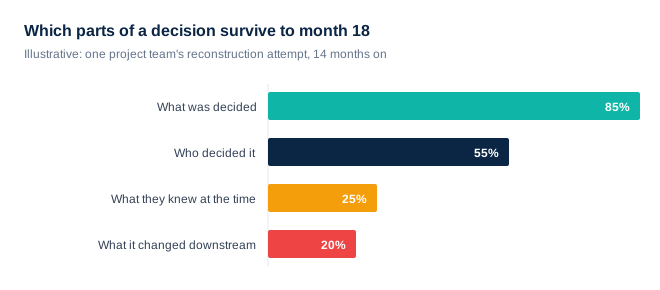
That's the loop closed. The reason the team couldn't reconstruct the decision wasn't missing paper. It was that the four facts had been scattered across four systems on four different days, and nothing had ever tied them into a single object.
“We'll remember” is a plan with an expiry date
Every undocumented decision is a bet that the people who made it will still be around, still recall the reasoning, and still agree with one another about it. On a two-year capital project that bet is merely optimistic. On the ten-year horizon where claims, audits and warranty disputes actually land, it is close to a certainty of loss. People move on. And memory doesn't simply fade — it reorganizes itself into a tidier story than the one that happened.
Run the reconstruct test tomorrow
Pick one decision from six months ago — a real one, with money attached. Hand it to somebody who wasn't involved and give them twenty minutes to tell you what was decided, by whom, on what information, and what it changed downstream. Twenty minutes, not five weeks. If they can't, you've just found out what your records are worth on the day someone finally asks.
The test rarely fails for the reason people expect. It's almost never that the records are missing —we take apart failures with this exact shape most days, and the culprit is nearly always connection, not volume.