One Chart: The 30-Day Records-Maturity Climb

Thirty days. No new software, no new headcount, no reorganization. In one capital-projects team, the time it took to answer “where is that approval?” went from most of a day to under five minutes.
The climb is the interesting part — not because the endpoint is impressive, but because of where the jump happens. It isn't in week one. Week one barely moves at all, which is exactly why most teams quit before they get paid.
What's being measured
Records maturity here is a simple composite score out of 100, averaged across five dimensions any team can rate for itself in an afternoon:
Findability — can a person who didn't file it find it?
Traceability — can you get from an outcome back to the decision that caused it?
Currency — is the version in front of you the version that governs?
Coverage — what fraction of consequential work leaves a record at all?
Auditability — could you show all of the above to a hostile stranger?
Score each dimension honestly out of 20. The temptation is to rate the system you designed rather than the one people actually use; if the two differ, rate the second one. Every team we've watched do this has scored itself lower on the second pass than the first, and the second number is the useful one.
The numbers below are illustrative: one team's month, not a benchmark. The shape of the curve is the part that repeats.
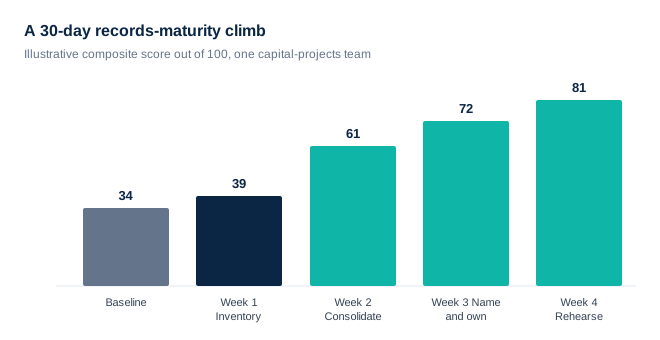
Week one does almost nothing. Week two does almost everything.
Week one is inventory: finding out what you have and where it actually lives, including the informal places nobody lists on an org chart. It produces almost no visible improvement, which is why it tends to be abandoned around day four. It is also the week that makes everything after it possible, because you cannot consolidate what you haven't found.
Week two is consolidation — one location per project, and a rule that says so. That single move accounts for most of the climb, and the reason is worth stating plainly: findability and currency collapse for the same underlying cause, which is two copies in two places. Remove the second place and you repair both at once.
Week 1 — Inventory. List where project records actually live today, including the informal places. Expect the list to be longer than anyone predicts.
Week 2 — Consolidate. One location per project. Everything else becomes a pointer to it. This is the week that moves the number.
Week 3 — Name and own. A naming convention a stranger could follow, and a named owner per record type. Cheap, dull, durable.
Week 4 — Rehearse. Pick three questions an auditor would ask and answer them cold, on the clock. Whatever breaks is your real backlog.
Weeks three and four move the score less, but they are what stops it sliding back. Naming and ownership let the consolidation survive contact with new people. And the rehearsal in week four is the only part of the month that tells you the truth, because it replaces your opinion of your records with evidence.
If you only do one week, do week two
That's the practical takeaway, and it is slightly annoying: the highest-value move is also the most boring one. Consolidation isn't a project. It's a decision followed by two weeks of tedium. But it is the difference between a records system that answers questions and a pile of files that merely stores them.
The week-four rehearsal is where most of the surprises live —we've written about what actually breaks under audit conditions, and it is rarely what teams expect going in.