The Day the Records Mattered Most

Nobody schedules the day. It arrives as an email from a lawyer, a letter from a regulator, a claim from a contractor, or a quiet question from the community that will live in the building you put up. And on that day, an organization finds out exactly what its records are worth.
This is the last piece in a month-long series, and the thirty days behind it have been a catalogue of different disasters. A missing approval. A version that drifted. An audit nobody rehearsed for. A person who left with the reasoning in her head. They look like separate problems. They aren't — and the thread connecting them is worth more than any individual fix.
Thirty days of different failures, one shape
Every one of those stories was about the same thing: an organization that could do the work but couldn't show its work. The doing was rarely the problem. The teams were competent, the decisions were mostly sound, the buildings got built. What failed was the ability to demonstrate, later and to somebody else, that any of that was true.
That gap — between having done something right and being able to prove it — is where cost overruns, disputes and lost trust actually live. It is a records problem wearing a project-management costume.
Records are a promise-keeping technology
It's worth saying plainly, because the word “records” makes people picture storage. Records are not storage. They are the mechanism by which an organization keeps promises to people who weren't in the room — including people who don't exist yet.
There is a test hidden in that word, promise. A promise you can't be held to isn't really a promise; it's an intention. The difference between the two is entirely a matter of evidence — which is another way of saying that an organization's integrity and its records aren't two separate things that ought to be aligned. They are the same thing, observed from inside and from outside.
The auditor wasn't in the room. Neither was the claimant, the successor team, the regulator, or the family living on the third floor fifteen years from now. Every one of them will eventually ask a version of the same question: what did you do, and why? An organization that can answer is accountable. One that can't is merely sincere.
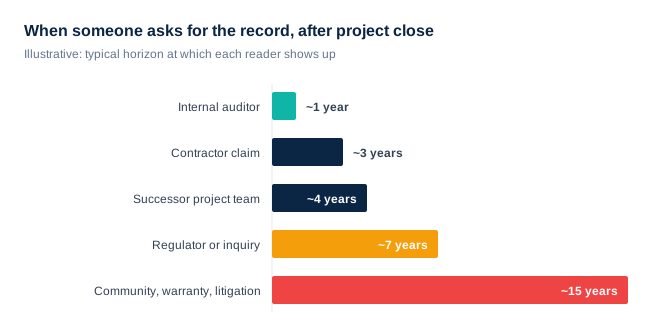
Look at the timescales. Most of the people who will interrogate your records are not in your current org chart, and several of them will arrive years after everyone involved has moved on. You are not keeping records for yourself. You are keeping them for strangers.
The day you need them is the day you can't build them
This is the whole argument, compressed. Every capability described in this series — traceable decisions, a single source of truth, project memory that survives turnover, records you could hand to a hostile reader — has to exist before the day it is needed. On the day itself there is nothing to be done. You either have it, or you are writing a very careful email explaining why you don't.
So the question isn't whether your records are good. It's narrower and more useful than that: if the day arrived this week, what would you not be able to show? Most teams can name it in about thirty seconds. That answer is your actual backlog — not the one in the system, the one in your stomach.
Closing that gap is the problem we built XNM-VISION to end, though the honest truth is that most of it is habit rather than software, and the thirty-second question above will get you further than any tool.The full series is here if you want to start at the beginning.