From Provider to Developer Overnight: The Record a Co-op Board Now Carries

In June, federal officials stood in St. Catharines to announce 492 new co-operative homes on a single site, backed by $183 million. It is the kind of announcement that changes an organization permanently. The month before, the sector partner behind it was a housing provider: leases, maintenance calls, member meetings, an annual audit. The month after, it was a developer - with a nine-figure capital project, a construction schedule, a funder carrying reporting conditions, and an obligation horizon measured in decades rather than in budget years.
That transition is where most non-profit and co-operative housing organizations discover their records were built for a different job. Filing that works perfectly well for tenancy files and board minutes is not a capital-project record: drawings and their revisions, consultant agreements, change orders, draw requests and the invoices supporting them, insurance certificates, permits and inspection reports, occupancy documentation, and the board resolutions that authorized each of them. The organizations doing this work are usually small - a handful of staff, a volunteer board that turns over every few years, and an executive director carrying most of the history personally. The project will outlast several of those people. The record is the only thing that reliably does.
Recent context
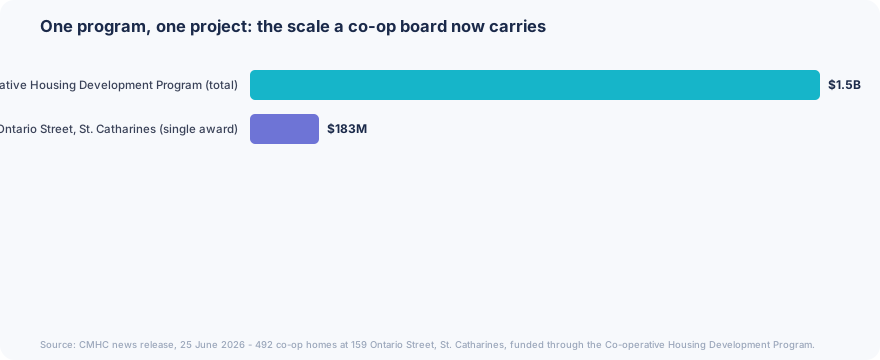
Ottawa is not assuming the sector already has that capacity. CMHC announced on 25 June 2026 that 492 homes at 159 Ontario Street in St. Catharines will be built with $183 million through the Co-operative Housing Development Program - at $1.5 billion, the largest federal investment in new co-op housing development in more than 30 years. The program was co-designed with the Co-operative Housing Federation of Canada and the co-op sector to address the sector's particular needs, and it explicitly includes capacity-building support for applicants. That last detail is the quiet admission inside the announcement: the capital is moving faster than the administrative machinery it lands in, and the program design accounts for it.
Capacity is not headcount - it is what survives a turnover
It is tempting to read "capacity" as staff, and staff certainly help. But in a small organization the binding constraint is rarely the number of people; it is how much of the project lives only in one person's head and inbox. Ask a practical question of any non-profit mid-build: if the executive director left tomorrow, could the organization show a funder - without a scramble - which drawing revision the current draw is based on, which change orders the board actually approved, and where the executed consultant agreements are? In most organizations the honest answer is that it would take weeks and several apologetic emails. That is not a filing problem wearing a governance costume; it is the reverse. A volunteer board cannot exercise oversight over a record it cannot see, and a funder cannot accept accountability it cannot trace. Nor does the obligation end at the ribbon-cutting: operating agreements, affordability covenants and reporting conditions run for decades, long past the tenure of everyone who signed them.
How XNM helps
XNM works with non-profit and community housing organizations taking on capital programs that are large relative to their administrative base. The practical work is unglamorous: getting the whole project record into one auditable place - drawings and revisions, agreements, change orders, draw packages, permits, insurance certificates and the board decisions behind them - organized by project and kept current as the build moves rather than reconstructed at reporting time. Where it fits, XNM-Vision is the command centre that holds it: one place where the board can see what it approved, where the executive director is not the single point of failure, and where a funder's request is answered by opening a file instead of rebuilding one. XNM brings the governance and execution discipline alongside it, so that an organization developing for the first time runs the project like one that has done it before.
Practical takeaways
Stand the project record up before the first draw. The habits set in month one are the habits you will still have in month thirty; retrofitting discipline onto a live construction file is far harder than starting with it.
Assume your executive director leaves mid-build. If that scenario would cost weeks of reconstruction, the institutional memory sits in a person rather than in the organization - and that is a risk the board owns, not the ED.
File board decisions with the documents they authorize. An approval recorded in minutes that nobody ever linked to the change order it approved is an approval you will struggle to evidence when a funder asks.
Treat funder reporting as an output, not a project. If the record is current and organized by project, a report is an extract; if it is not, every report becomes a small excavation.
Plan for the decades, not the build. Operating agreements and affordability covenants outlive the construction file and most of the people who signed them - retention is part of the deliverable, not an afterthought.
FAQ
We have a project manager and a consultant. Isn't the record their job?
They hold their own records, and they should. But a consultant's file is scoped to the consultant's mandate and leaves with them at closeout, and a project manager's working set is not the same thing as the owner's governed record. The organization that signed the funding agreement is the one that has to answer for it in year twelve - so the owner's copy has to be complete, current and under the owner's control, rather than assembled from other people's servers after the fact.
We're a small organization. Isn't this a lot of overhead for one project?
The overhead already exists; it is simply being paid in the worst available currency - evenings spent reconstructing files, draws delayed while someone chases a certificate, and board meetings spent on questions the record should have answered on its own. Putting the record in one governed place is not extra work bolted onto the project. It is the same work, done once, in a form that answers the next question automatically.
The bottom line
Federal money for community housing is moving at a scale the sector has not seen in a generation, and it is landing inside organizations whose administrative machinery was built for a smaller job. The programs themselves acknowledge the gap by funding capacity-building. The organizations that come through the next few years with their reputations and their funding relationships intact will not be the ones with the biggest teams. They will be the ones whose record could still answer the question long after the people who built it had moved on.