Your Own File First: Engagement Records, Retention and File Review in an Audit Practice

An accounting firm's product is an opinion, but its evidence is a file. Everything a firm asserts - that the risks were identified, the procedures performed, the judgments reasoned, the review carried out, the independence confirmed - lives or dies in engagement documentation that will be read long after the engagement closed, by someone who was not in the room and cannot ask. The work may have been excellent. If the file does not show it, the position is weaker than the work.
The practical difficulty is that a firm's records obligations run in several directions at once. Engagement documentation has to be assembled on a deadline and then retained, unaltered, for years. Quality-management standards require monitoring, including inspection of completed engagements. Regulators and provincial bodies can ask. Clients change hands, partners retire, audit software is replaced, and the firm is still accountable for a file created under a previous system by people who have left. When engagement records sit partly in a practice-management tool, partly on a network drive, partly in email threads that captured the real judgment call, and partly in a retired partner's memory, the firm's exposure is not theoretical - it is a specific file, on a specific engagement, that nobody can fully reassemble.
Recent context
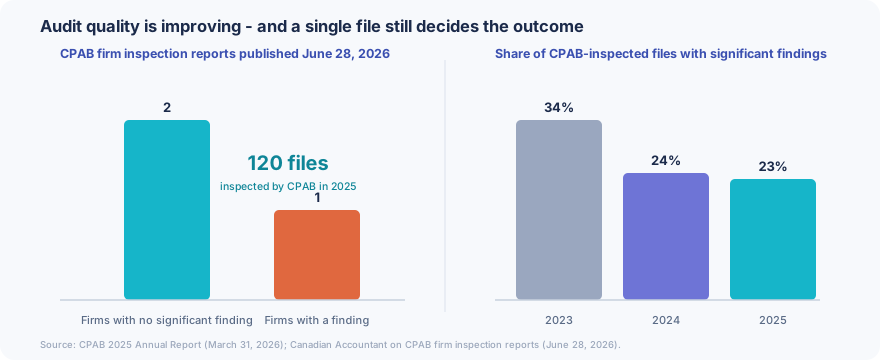
The profession's direction is encouraging, and the stakes on the individual file have gone up rather than down. In three firm inspection reports published on June 28, 2026, the Canadian Public Accountability Board reported no significant findings for two firms - terminating one firm's prohibition on accepting new high-risk reporting issuers - while a single significant finding in one of two files inspected at a third firm was enough to keep that firm's restriction in place. The aggregate picture is improving: CPAB's 2025 annual report, published March 31, 2026, showed significant findings in 23 per cent of the 120 files inspected, down from 24 per cent in 2024 and 34 per cent in 2023, with CPAB crediting firms' systems of quality management for greater consistency. Improvement at the profession level and consequence at the file level are both true at once.
Retention is a control, not a storage problem
It is easy to treat retention as a filing question - keep it somewhere, keep it long enough. In an audit practice it is closer to a control. The value of engagement documentation depends on being able to show not only what is in the file but that it has not changed since assembly, who reviewed it and when, and that the review actually preceded the report. That chain is what a monitoring programme tests and what an inspector reconstructs. It is also what quietly degrades: a file migrated between systems loses its review metadata, a working paper saved to a personal folder never makes it back, an email that documents the substantive judgment is not in the file at all. None of that is misconduct. It is drift, and drift is what turns a good engagement into a finding. Firms that fare well are usually not the ones with the most documentation; they are the ones whose file is complete, organized and demonstrably unaltered without anyone having to go looking.
How XNM helps
XNM helps professional firms bring the record around their engagements into one governed, auditable place - engagement letters and acceptance decisions, independence confirmations, the correspondence and approvals that sit outside the audit file, retention schedules, and the results of internal file review and monitoring, organized by client and engagement and kept current. Where it fits, the XNM-Vision platform gives partners one line of sight across engagements at once, with a server-side audit trail showing who accessed or changed what and when, so a monitoring cycle, a regulator's request or a client transition meets a complete, time-stamped record rather than a reconstruction. It does not replace audit software or perform the engagement; it makes sure the firm's own governed record of what was agreed, approved, reviewed and retained is there when it is needed.
Practical takeaways
Assume every file will be read by a stranger. Documentation that only makes sense to the person who wrote it is the most common source of findings; write for the reviewer who has no context and cannot ask.
Make review evidence part of the file, not around it. Who reviewed, when, and what changed as a result is what an inspection tests - keep it attached to the engagement, not in a separate tracker.
Treat retention as a control with an owner. Someone has to be accountable for the fact that a file is intact, unaltered and retrievable years later, across a software change or a partner's retirement.
Capture the judgment where it actually happened. The reasoning frequently lives in email or a call; if it is not brought into the engagement record, the file will not show the firm's best work.
Run monitoring as a habit, not an event. Standards require inspection of completed engagements; a steady internal cycle finds the gap while it can still be understood and explained.
FAQ
Our audit software already holds the engagement file. What is missing?
Usually the material around the file rather than in it: engagement letters and acceptance decisions, independence confirmations, fee and scope changes agreed by email, client correspondence that documents a judgment, retention schedules, and the firm-level results of monitoring and internal file review. Audit software is built to run the engagement. The firm still needs its own governed record of the commitments and decisions that surround the engagement, and a way to see across engagements at once.
We are a smaller firm and not subject to CPAB inspection. Does this apply?
The inspection regime differs, but the underlying obligations do not disappear. Quality-management standards require monitoring that includes inspecting completed engagements, provincial bodies conduct practice inspections, and retention obligations apply regardless of firm size. Smaller firms often carry more concentrated risk, because the file, the judgment and the memory frequently belong to the same one or two people.
The bottom line
The profession is getting better at this, and that is worth saying plainly. It also means the remaining findings are increasingly about the file rather than the work. A firm that can produce any engagement - complete, reviewed, unaltered and on short notice - has already answered most of the questions an inspection will ask.