Cutting Permits, Tenure and Proof: Why Forestry Runs on Its Compliance Record

Forestry is one of the most document-dependent industries in Canada, and the documents are unusually long-lived. A right to harvest is not a single permission. It is a licence or tenure agreement, the cutting permits issued under it, the stewardship or management plan those permits must conform to, the consultation and accommodation record with affected First Nations, the road and stream-crossing approvals, and the cut-control reporting that proves what was taken against what was allowed. Any one can be requested by a regulator, an auditor, a lender or a partner, and each means little unless the others behind it can be produced too.
What makes this harder than it sounds is duration. Allowable annual cut determinations and management plans run on multi-year cycles; cut control is assessed over a standard five-year period; tenures outlast the careers of the people who negotiated them. Over that span staff turn over, mills change hands, and the operating file drifts into a mix of drives, permit portals, consultant deliverables and paper. The result is a familiar quiet risk: an operator whose practices are entirely lawful but not readily provable, finding the gap only when someone with authority asks - during a transfer, an audit or a compliance review, exactly when reconstruction costs most.
Recent context
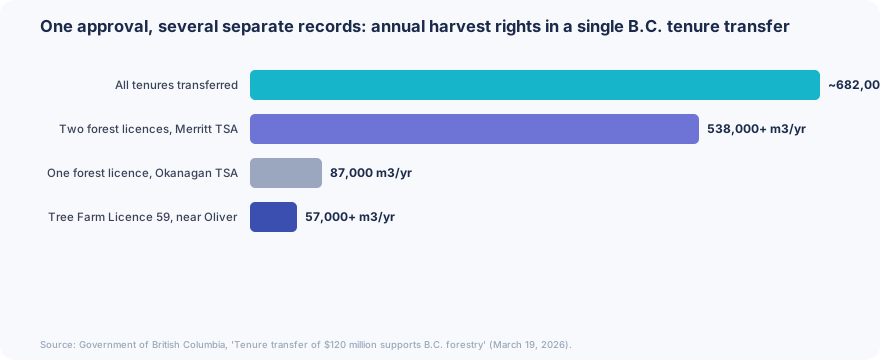
A recent transfer shows how much record moves at once. British Columbia announced in March 2026 that the Minister of Forests had approved the transfer of tenures from Weyerhaeuser to the Gorman Group, completing a $120-million investment: 46,000 hectares of Tree Farm Licence 59 near Oliver carrying more than 57,000 cubic metres of harvest a year, two replaceable forest licences in the Merritt timber supply area carrying more than 538,000 cubic metres a year, and one in the Okanagan carrying almost 87,000. The ministry received nearly 300 letters of support during the public comment period from individuals, businesses, First Nations, contractors, community forests and unions. Each instrument arrived with its own history and obligations attached.
Policy is moving toward permits, which means toward records
The regulatory direction of travel adds to the load rather than reducing it. Ontario's ten-year forestry roadmap, launched in the spring, sets out to defend, adapt and grow a sector reported at close to $21 billion in revenue and more than 154,000 jobs, with 97 per cent of forest product exports going to the United States, and it explicitly aims to lower regulatory barriers. Streamlining is welcome, but it does not remove obligations; it front-loads the evidence a faster decision depends on. British Columbia is moving in parallel on fibre, expanding its BC Timber Sales value-added manufacturing program to custom cutters and processors - roughly 30 to 40 businesses employing about 250 people and using around 800,000 cubic metres of wood a year, in a sector that generated more than $1.3 billion in GDP in 2024. New categories bring new eligibility, allocation and reporting records.
How XNM helps
XNM helps forestry operators and First Nations forestry enterprises pull the tenure and compliance record into one auditable place: licences and tenure agreements, cutting permits and their conditions, management and stewardship plans, consultation and accommodation records, road and crossing approvals, cut-control reporting, and the certification and audit trail that ties them together. Where it helps, the XNM-Vision platform keeps that chain current across licences and years rather than in the memory of whoever last handled it, so a regulator's request, a certification audit or a tenure transfer meets a complete record. XNM brings the governance and execution discipline; the record and the decisions remain the operator's.
Practical takeaways
Keep the permit with the plan it must conform to. A cutting permit is only defensible alongside the management plan and conditions it was issued under.
Treat the consultation record as substantive, not procedural. What was raised and how it was accommodated is the part that gets tested, and it has to be retrievable years later.
Build cut-control evidence as you go. Compliance is assessed over multi-year periods; reconstructing volumes after the fact is the slowest way to answer.
Prepare tenure records before a transfer, not during one. Approvals move faster when each instrument's history, conditions and obligations are already assembled.
Expect new programs to bring new records. Eligibility, allocation and reporting obligations arrive with every new category an operator qualifies for.
FAQ
Our permits are all in the provincial system. Isn't that the record?
The provincial system holds the instruments; it does not hold your evidence of compliance with them. Monitoring results, consultation history, internal approvals, contractor obligations and the reasoning behind operational decisions are yours to keep. The government file says what you were allowed to do. Your own record shows what you did and why.
We are certified. Doesn't the audit cycle keep this in order?
Certification audits test a sample against a standard on a schedule; they do not replace a continuous record. In practice a well-kept file makes the audit cheaper and less disruptive, because evidence is produced rather than assembled. Teams that treat the audit as the moment to organize the record pay for that organizing again every cycle.
The bottom line
In forestry the right to operate is a stack of documents held over decades and tested by people who were not there when they were signed. Keeping tenure, permits, plans, consultation and cut-control evidence current and connected is not tidiness - it is what makes the licence defensible.