Before the Ice Goes Out: Why the Northern Record Has to Be Ready Before the Build Season Opens

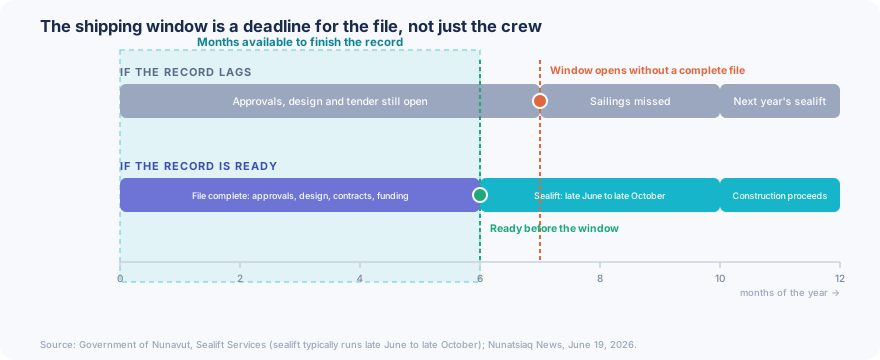
In most of Canada a construction schedule is a negotiation. In Inuit Nunangat it is closer to physics. Materials for a building in a Nunavut community generally arrive by sealift, and sealift typically runs between late June and late October. Miss a sailing and the consequence is not a two-week slip; it is a year. That constraint reorders everything upstream of it. Design, approvals, tenders, executed contracts, funding confirmations and freight bookings all have to be settled before the window opens, because the window does not wait for a file to catch up.
Inuit governments and Inuit organizations carry a heavy documentary load for the size of the teams that carry it. A single community project can involve a land-claim organization, a territorial department, a hamlet council, a federal funder with its own reporting cycle, and a contractor mobilizing from thousands of kilometres away. The record that holds it together - design set, land tenure and permits, council resolutions, the contribution agreement, change orders, freight manifests - is often spread across drives and inboxes in three or four organizations at once. In a southern city that is merely inefficient. Where one shipping season serves the community, it decides whether there is a building.
Recent context
The scale of what moves each summer is easy to underestimate. Nunatsiaq News reported in June 2026 that Nunavut's public housing waiting list had grown to 3,713 applicants as of March 31, 2026, up from 3,348 a year earlier, with 20 communities in critical need and roughly 45 per cent of the territory's 6,135 public units overcrowded. Against that, 313 units have been completed since the Nunavut 3000 target was set and 352 more are under construction - and the corporation described plans for 167 public units and 10 staff units across 16 communities this summer as among the largest co-ordinated builds in the territory's history.
The build season is a deadline for the file
It is tempting to treat documentation as the paperwork that follows a decision. In the North the order is reversed: the paperwork is what makes a decision shippable. A design that is not final cannot generate an accurate materials list; an unfinished list cannot be procured; an uncommitted purchase cannot be booked on a sailing. Each step depends on the one before it, and the chain has to close months before the first ship loads. The logic holds after the ice goes out too: a gap found on site in August cannot be fixed by ordering a part, because the part is not coming until next year. Tighter budgets sharpen it. Nunavut's housing corporation was allocated $87.2 million in the 2026-27 capital budget, down from $109.7 million a year earlier.
How XNM helps
XNM helps Inuit organizations and their territorial and municipal partners pull a project's record into one auditable place: the design set and its revisions, land tenure and permits, council and board resolutions, contribution agreements and their reporting obligations, contracts and change orders, and the materials and freight record that ties a decision to a sailing. Where it helps, the XNM-Vision platform gives a project team one line of sight across a whole community program, so a season-critical gap surfaces in the spring when it can still be closed. XNM works as an author and a partner alongside the client's own people; the record stays the client's, and so do the decisions made from it.
Practical takeaways
Work back from the sailing. Fix the last date a purchase can be committed and still make a ship, then set every approval deadline behind it.
Treat an unfinished design as a schedule risk. A design that is not final cannot produce a defensible materials list, and a soft list becomes next year's shortfall.
Keep the funding record beside the build record. Contribution agreements carry their own reporting cycles; kept apart, reporting becomes a second project.
Make the record legible across organizations. The file spans several bodies and must be usable by all of them without re-keying.
Capture change while the season is open. A change documented in August is manageable; reconstructed in November it has already cost a year.
FAQ
Our contractor holds the freight detail. Isn't that their job?
Running their own supply chain is their job. But the organization that owns the asset answers for the money, the schedule and the outcome, and that needs its own complete file: approvals, the contract and its changes, funding conditions, and enough of the freight record to know whether the season is on track. Relying on a contractor's system for evidence you are accountable for is a risk anywhere; where a gap costs a year, it is expensive.
We are a small team. Is a governed record realistic for us?
It matters more for a small team, not less. A large organization can absorb a scramble with people; a three-person capital team cannot. The point is not more process, it is fewer places to look, so the same team can answer a funder or a council from one current picture instead of assembling one mid-season.
The bottom line
In the North the record is not administrative overhead. It is a logistics instrument. Sealift runs roughly late June to late October, and everything that has to be on a ship must be decided, approved, contracted and documented before it. Treat the file as the season's first deliverable, not its last.