The Change Order Is the Contract: Where Capital Cost Control Actually Lives

Almost no capital project fails in one dramatic moment. Budgets erode gradually, through changes that each looked small at the time. A site condition differs from the drawings; a user group asks for a modification; a code interpretation shifts. Each becomes a change order, and each change order quietly amends a contract that a board, a council or a funder approved. The contract sets the price and the rules. The change orders are what the project actually cost. If the record of those changes is thin, an owner governs the document it signed rather than the project it is paying for.
The control problem is rarely a lack of process. Most owners have a change-order procedure. The problem is that the evidence it depends on lives somewhere else: the request in an email, the pricing in a consultant's memo, the justification in a meeting nobody minuted, the approval on a form filed apart from the contract it modifies. Separated like that, nobody can answer the two questions that matter - was this change necessary, and was it priced according to the contract - without reassembling the file. On a live project with a schedule to protect, the pressure is always to approve first and reconcile later.
Recent context
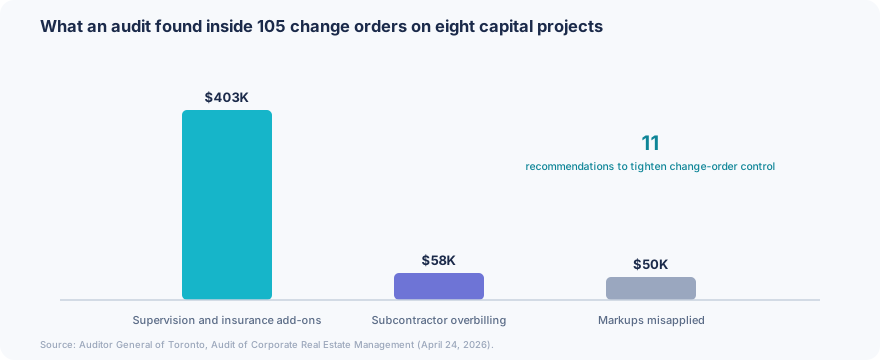
A municipal audit published this spring shows the pattern in detail. The Auditor General of Toronto's April 2026 audit of corporate real estate management examined 105 change orders across eight capital projects and found $403,000 in extra charges for supervision, project management, insurance and bonding on 35 per cent of them, about $50,000 in overcharges where markups were not applied per contract terms on 48 per cent of the change orders, and $58,000 in overbilling for subcontractor work, with more than $500,000 in further charges still under investigation. It found limited evidence that project managers independently reviewed change orders and their supporting documents, and no centralized construction project management system to reveal the trend.
Small amounts, structural cause
None of those figures would sink a project on its own. That is the point. They are the visible edge of a control gap: an owner relying on the same consultants who designed the work to judge whether a change is necessary and fairly priced, with no independent review and no single system where the pattern would show. Scale matters. Statistics Canada reported investment in building construction of $23.4 billion in May 2026, up 5.9 per cent year over year, $7.1 billion of it non-residential. A percentage point of unmanaged change across a portfolio that size is no rounding error, and the owners exposed to it are those who cannot show, contract by contract, what was approved and on what basis.
How XNM helps
XNM helps owners bring the contract record and its changes into one auditable place: the executed contract and its schedules, each change request with the condition that prompted it, the pricing and how it was tested against the contract's markup terms, the approval and who gave it, and the resulting movement in budget and schedule. Where it helps, the XNM-Vision platform keeps that chain visible across a portfolio rather than one project at a time, so a pattern - a recurring markup error, design changes that keep returning as extras - surfaces while it can still be corrected. XNM brings the governance and execution discipline; the decisions, and the record, remain the owner's.
Practical takeaways
File the change order with the contract it amends. Stored apart from its contract, a change order cannot be checked against the terms that govern its pricing.
Test markups against the contract, every time. Misapplied markups recur in change-order audits precisely because nobody re-reads the clause.
Get a review independent of the designer. Where the party that designed the work also judges whether a change is needed, the owner has no second opinion.
Record the cause, not just the cost. A site condition, a scope addition and a design error are not the same thing, and they do not fall to the same party.
Look across projects, not just within one. Single change orders look minor; the same error repeated across a portfolio is a control failure with a number attached.
FAQ
Our consultant reviews every change order. Isn't that the control?
It is one input, and a necessary one. But when the firm that designed the work also assesses whether a change is required, the owner has no independent check on the question it most needs answered. The Toronto audit noted exactly this, along with the absence of consistent tracking of design errors. An owner-side review need not duplicate the engineering; it needs the file, the contract terms and someone accountable for asking whether both were followed.
We are mid-project. Is it too late to tighten this up?
No. Most of the value is forward-looking: from the next change order on, keep the request, the cause, the pricing test, the approval and the budget movement together. Reconstructing earlier changes is worth doing where the amounts justify it, but the immediate gain is that the remaining changes stop widening the gap.
The bottom line
An owner governs a capital project through its contract and amends it through change orders. If those amendments are approved quickly and evidenced thinly, the contract stops describing the project. Keeping the change record complete, priced against the contract and independently reviewed is not administration - it is the cost control.