Capital Renewal on the Record: What School Districts Owe Their Funders

A school district is one of the few public bodies that owns a great deal of property and controls almost none of the money to renew it. Roofs, boilers, seismic structure, portables, accessibility, ventilation - the list of what ages out is long and predictable, and the process for replacing any of it is the same every year: build a case, submit it to a provincial ministry, wait for a decision that may not come, and if it does come, account for the money in a format the funder specifies. That cycle turns facilities work into a documentary discipline. The condition data, the enrolment projections, the board resolution behind the submission, the approval letter and its conditions, the tender, the change orders, the substantial-completion certificate and the final claim are one continuous chain, and a district's credibility with its funder is built out of how well that chain holds together year over year.
In most districts it does not hold together in one place. Facility condition assessments sit with a consultant or in an asset-management tool. Enrolment projections sit with planning. The capital submission sits in whatever format the ministry required that cycle. The approval letter sits in the secretary-treasurer's email. Tender documents and contracts sit with purchasing, site records with the project manager, and the claims with finance. Nobody in that chain is careless; the chain simply has no single owner. The cost shows up in two places - in the next submission, where a district has to re-derive evidence it already produced, and in the next audit, where the question is not whether the money was spent well but whether the district can show it was spent on what the approval actually authorized.
Recent context
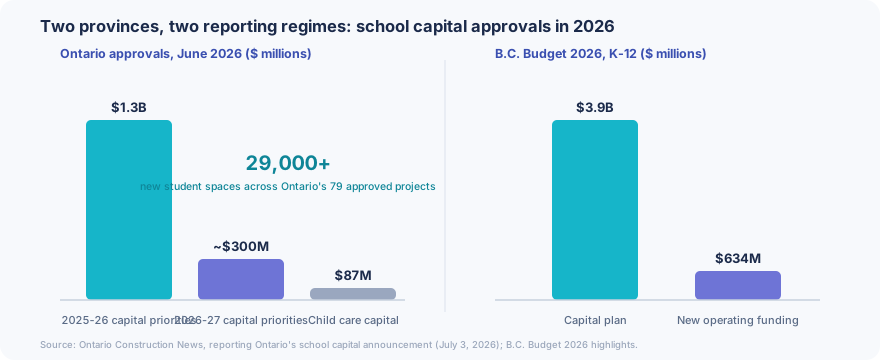
The approvals themselves are moving. Ontario approved $1.6 billion for 79 school construction and renewal projects in June 2026 - 67 of them under the 2025-26 capital priorities program and 12 under 2026-27, plus $87 million in child care capital - creating more than 29,000 new student spaces and over 1,900 licensed child care spaces. In British Columbia, Budget 2026 allocated $3.9 billion in K-12 capital for seismic replacements, upgrades and enrolment growth, covering 66 major additions and improvements, alongside $634 million in new operating funding. Different provinces, different programs, the same pattern: money is released against a submission, and it is accounted for against that submission's terms.
The submission and the claim are the same document, years apart
The most useful reframing for a facilities team is that a capital submission and a final claim are two views of one record. The submission argues from evidence - this building's condition, this school's enrolment pressure, this cost estimate, this board decision. The claim, sometimes three or four years later, has to demonstrate that what was built matches what was argued, at a cost the approval contemplated, through a procurement that met provincial rules. When those two ends are maintained separately, the district spends the intervening years quietly losing the thread: the scope changed twice, the estimate was superseded, the person who wrote the original justification retired. Districts that carry the record forward as one file get two advantages that compound. Their claims close faster because the evidence is already attached, and their next submission is stronger because a funder can see a track record of projects delivered as described. In a competitive capital-priorities process, that credibility is a real asset.
How XNM helps
XNM helps school districts pull the capital-renewal record into one auditable command centre - condition assessments and enrolment data, the board resolution and the submission built from them, the approval and its conditions, the procurement file, drawings, site records and change orders, and the claims and reports filed against each approval, organized by project and kept current. Where it fits, the XNM-Vision platform gives a secretary-treasurer, a facilities director and a board one line of sight across the whole capital program, so a ministry question or an auditor's request is answered from a complete, time-stamped file rather than a search across four systems. The aim is not to replace an asset-management tool or a finance ledger; it is to hold the thread between the case a district made and the money it accounted for.
Practical takeaways
Keep the submission and its evidence together. The condition data and enrolment projections that justified a project are the same evidence you will need to defend it at closeout; file them with the submission, not beside it.
Attach the approval conditions to the project. Approvals arrive with scope, cost and procurement terms; a condition that lives only in an email is a condition nobody will check until it is audited.
Log scope and cost changes against the original case. When scope moves, record what changed relative to what was approved - that comparison is exactly what a funder asks for later.
Build the record for a multi-year gap. Three or four years pass between approval and final claim; assume the staff, the consultants and the format will all change in that window.
Treat delivery history as a credibility asset. A funder deciding between competing submissions notices which districts can show projects delivered as described.
FAQ
We already have an asset-management system with all our facility condition data. Isn't that the record?
Condition data is the input to a submission, not the record of the project it justified. What a ministry or an auditor asks about later is the chain: which condition finding supported which submission, what the board approved, what the ministry approved, what was tendered and built, and what was claimed. Asset-management tools rarely carry that chain, because it is a governance and funding record as much as a technical one.
Our capital projects are small - roofs, boilers, upgrades. Does this matter at that scale?
Renewal work is where the volume is, and volume is the problem: dozens of small approvals, each with its own conditions and claim deadlines, are harder to keep straight than one large build with a dedicated project team. The discipline is the same and the payoff is faster, because a district running many small projects loses the most time to reconstructing routine paperwork.
The bottom line
A school district's capital program is a long argument with its funder, conducted in documents over several years. The buildings are the outcome, but the record is the instrument - it is what wins an approval, what closes a claim, and what makes the next submission credible. Keep it as one file that survives the gap between the case and the cheque.