Which Drawing Did They Build From? Revision Control as a Liability Record

For an engineering or architecture firm, the deliverable is not only the drawing. It is the evidence of which revision was issued, on what date, to whom, and under whose seal - along with the comments that shaped it, the checks that cleared it and the decisions the client made along the way. Design work is judged years later, usually by someone reading the file rather than the building, and usually after something has gone wrong. In that setting a firm's record is not administrative housekeeping. It is the defence.
Most firms know this and still carry real exposure, because the record is spread thin. A revision goes out by email because the client needed it that afternoon. A markup lives in one reviewer's PDF and never makes the transmittal. A field change is agreed in a site meeting and captured only in someone's notes. A sub-consultant's package is filed on their server, not yours. None of it is negligence, and most of it is invisible - until a claim arrives and the question becomes narrow and unforgiving: which drawing did they build from, and can you prove what you issued? A firm with excellent engineering can lose that argument to a firm with better records.
Recent context
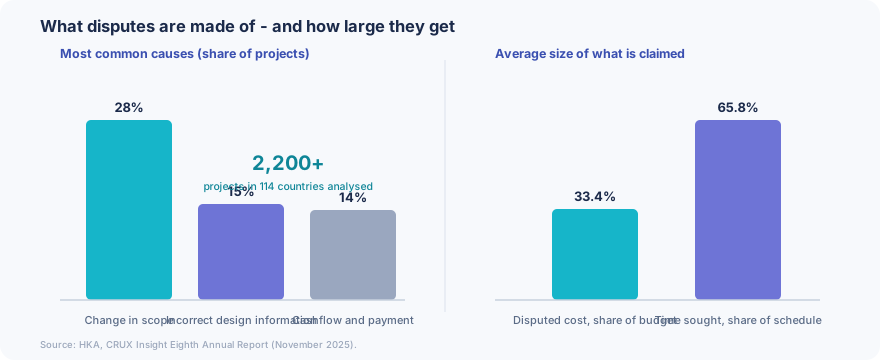
The numbers on where disputes come from have been remarkably stable. HKA's eighth annual CRUX Insight report, covering more than 2,200 projects across 114 countries with a combined capital value of $2.433 trillion, found change in scope remains the most common cause of claims and disputes at 28 per cent of projects, with incorrect design information affecting over 15 per cent since 2020 and cashflow or payment issues 14 per cent. The consequences are not marginal: disputed costs averaged 33.4 per cent of contract budgets, and the time sought averaged 65.8 per cent of planned schedules. Insurance-side reporting in July 2026 described architects and engineers professional liability claims rising in frequency, severity and complexity through 2025, with structural, civil and geotechnical engineering and architecture facing the most pressure.
Scope disputes are usually document disputes
It is worth being precise about what 'change in scope' means on the ground. Very often it is not a disagreement about the work; it is a disagreement about what was communicated and when. Someone built to a superseded sheet. A revision was issued but never formally acknowledged. A client instruction was verbal and later remembered differently. A design assumption changed because of information that arrived late, and the sequence is now contested. Each of those is settled by transmittals, revision histories, comment logs and dated approvals - or it is not settled at all. That is why deliverable QA is a liability control rather than a formality: the check that catches a stale reference also creates the evidence that the check happened.
How XNM helps
XNM helps engineering, architecture and consulting firms hold the deliverable record in one governed place - drawing sets and their revision history, transmittals and acknowledgements, review comments and their resolution, sub-consultant packages, client instructions and approvals, and the QA checks behind each issue, organized by project and kept current. Where it helps, the XNM-Vision platform gives principals and project leads one line of sight across every active project's document trail, so a question about what was issued is answered from the record rather than from memory, and a claim years later meets a complete, time-stamped file. The aim is not to replace a CAD or BIM environment; it is to make the surrounding evidence findable and defensible.
Practical takeaways
Make the transmittal the moment of record. If a revision leaves the office any other way, the firm has issued a drawing it cannot prove it issued.
Close the loop on every comment. A review comment with no recorded resolution is an open question a claimant will find years later.
Capture verbal instructions in writing the same day. Site decisions and client calls become contested facts; a short dated confirmation is worth more than anyone's recollection.
Hold sub-consultant deliverables in your own record. Your seal and your exposure do not end at the boundary of someone else's server.
FAQ
Our document management is inside our CAD and BIM tools. Isn't that enough?
Those tools manage the model and the drawing extremely well. What tends to sit outside them is the surrounding evidence - the transmittal, the client's acknowledgement, the emailed instruction, the sub-consultant's package, the QA sign-off. A claim is usually argued on exactly that material.
We are a small firm. Is this level of discipline proportionate?
The exposure does not scale with firm size; a single project can exceed a small practice's capacity to absorb it. The practical version is modest: one place where issued revisions, transmittals, comments and approvals live, and a habit of putting things there the day they happen.
The bottom line
Design liability is decided on documents. Keep the revision history, the transmittals and the approvals in one governed record as the work happens, and a claim meets an answer instead of a reconstruction.