The Council Record Is the Capital Program

Every road, water main, arena and transit expansion a municipality builds starts as a decision written into a council minute. The staff report that framed the options, the resolution that authorized the budget, the delegation that let staff award a contract, the bylaw that borrowed the money - those are not paperwork surrounding the capital program. They are the capital program. Every tender, every change order and every grant claim downstream traces its authority back to a council decision, and the ability to produce that chain on demand is what separates a program that answers an audit in an afternoon from one that spends a month reassembling itself.
The difficulty is that the chain is almost never in one place. Minutes sit in the clerk's system. Staff reports sit on a shared drive. Tenders and contracts sit with purchasing, drawings and inspection reports with engineering, and funding agreements, claims and progress reports in the inboxes of whoever wrote them. Each system is defensible on its own. Together they make a simple question - what did council approve for this project, at what value, under what conditions, and what has been claimed against it - surprisingly slow to answer. In a small or mid-sized municipality the person who knows how the pieces connect is often one person, and one retirement away from being a single point of failure.
Recent context
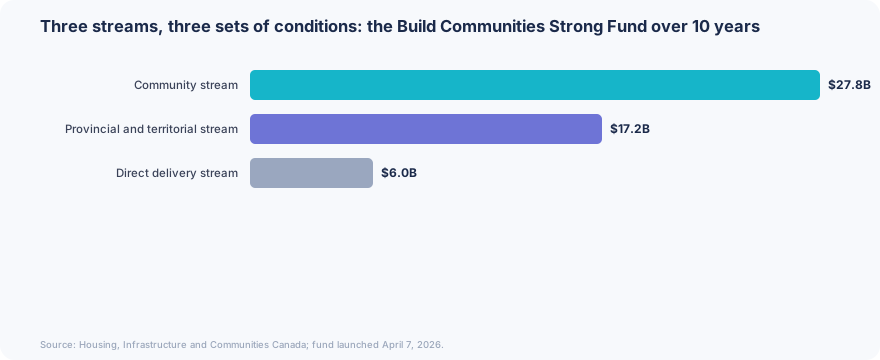
The stakes have just risen. The Build Communities Strong Fund, launched April 7, 2026, commits $51 billion over ten years and $3 billion annually on an ongoing basis, across a $27.8-billion community stream, a $17.2-billion provincial and territorial stream and a $6-billion direct delivery stream, opening with 13 projects and roughly $300 million in federal funding. The conditions matter as much as the money: provinces are expected to cost-match and to reduce development charges, at least 20 per cent of provincial and territorial funding must reach rural, Northern and Indigenous communities, at least 10 per cent of direct-delivery funding must support Indigenous-led projects, and Buy Canadian procurement applies. Every one of those conditions is proven, or not, in a municipality's own file.
Why the council record is load-bearing
Municipalities maintain roughly 60 per cent of Canada's essential infrastructure on about eight cents of every tax dollar collected in the country, which means most local capital work is assembled from transfers, each with its own eligibility window, cost-sharing rule and reporting cycle. That structure puts the council record under a load it was never designed for. A resolution is no longer just a governance artifact; it is the evidence that a project was authorized inside the eligibility period, that the local share was approved, that the procurement followed the policy council adopted, and that the amount claimed matches the amount council actually committed. When a funder, an auditor or a resident asks, the answer is only as strong as the ability to line those documents up against each other. The municipalities that move fastest through a funding round are rarely the ones with the most staff; they are the ones whose record was already assembled.
How XNM helps
XNM helps municipalities pull the capital-program record into one auditable command centre - the staff report and the resolution that authorized a project, the funding agreement and its conditions, the procurement file, drawings and inspections, change orders, and the claims submitted against each agreement, organized by project and kept current. Where it fits, the XNM-Vision platform gives a CAO, a clerk and an engineering team one line of sight across the whole program, so a council decision, a contract award or a grant claim is backed by its evidence the moment it is questioned. The aim is not to replace the clerk's system or the finance ledger; it is to connect what council decided to what was spent and claimed, so scrutiny meets a complete record rather than a reconstruction.
Practical takeaways
Index the capital program by project, not by department. A project's authority, contract, drawings and claims live in four systems; the record has to be assembled around the project or nobody can see it whole.
Attach the funding conditions to the file. Cost-matching, rural and Indigenous allocation targets and Buy Canadian rules are audited later; keep the condition and the proof it was met together.
Treat the resolution as the anchor document. Every downstream commitment traces to a council decision; if the resolution cannot be found quickly, nothing beneath it can be defended quickly.
Do not let one person be the index. Institutional memory is not a records system; write down how the pieces connect before the person who knows retires.
FAQ
Our clerk's system already holds minutes and bylaws. Isn't that the record?
It holds the decisions, which is essential but not sufficient. What an auditor or a funder asks about is the link between a decision and its consequences - the contract awarded under it, the change orders that moved its budget, the claim filed against it. The governance record and the project record have to be readable together, or each half is only half an answer.
We are a small municipality with a handful of active projects. Is this overkill?
Smaller municipalities usually carry more concentration risk, not less, because the same person often handles the report, the tender and the claim. The point is not a large system; it is that the connection between authority, spending and reporting survives a vacation, a resignation or a change in council.
The bottom line
A municipal capital program is a governance record with construction attached. The money arrives with conditions, the conditions are proven in documents, and the documents only mean something if they can be lined up against the council decision that authorized them. Get that connection right and a funding round, an audit and a question from the horseshoe all draw on the same current file.