The File Behind the Homes: Records Discipline in a First Nations Housing Program

A First Nations housing program is judged by the homes that get built. It is funded, audited and renewed on the record behind them. Before a foundation is poured, a multi-unit build has already produced a council resolution, a funding application, a lot designation, a design package, a tender and a construction contract. After occupancy it keeps producing: draw requests, inspection reports, deficiency lists, warranty claims, maintenance histories and year-end reporting to more than one funder. The homes are the outcome. The file is the machinery.
That machinery usually runs on whatever is at hand. In an administration where housing manager, capital coordinator and finance officer may be three roles held by two people, the record for an eight-unit build ends up split across a shared drive, an email inbox, a consultant's server and a spreadsheet only one person fully understands. Nothing looks wrong until something is asked. A funder wants proof a milestone was met before it releases the next draw. An auditor asks which council motion authorized a change. The decisions were sound; the evidence is scattered. For a Nation running its own capital program, the gap between good decisions and provable ones is the real exposure.
Recent context
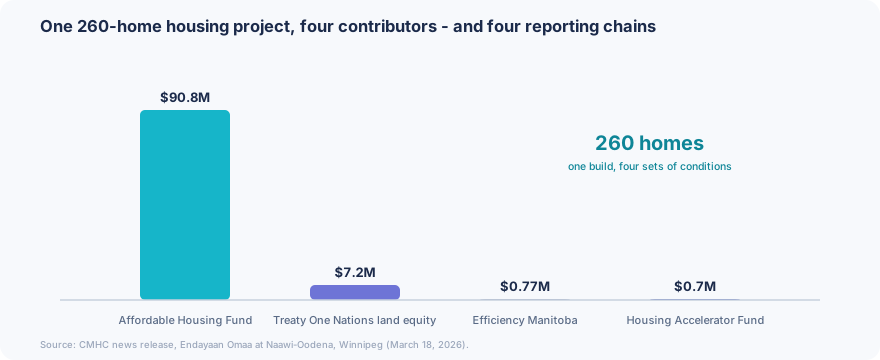
Programs are getting larger, and the reporting attached to them is getting denser. CMHC's March 2026 announcement with Treaty One Nations set out a $91-million project to build 260 homes at Naawi-Oodena in Winnipeg, drawing $90.8 million from the Affordable Housing Fund, $700,000 from the Housing Accelerator Fund, $7.2 million in land equity from Treaty One Nations and $765,000 from Efficiency Manitoba - alongside commitments including a minimum 30 per cent Indigenous workforce. Indigenous Services Canada, in its 2026-27 Departmental Plan, sets planned housing spending of roughly $1.42 billion and reports 72.9 per cent of First Nations housing as adequate in 2024-25, against a 75 per cent target for March 2028.
Every commitment in a funding stack is a records obligation
Stack several funders on one project and you do not have several cheques; you have several sets of conditions, timelines and reports, all pointing at the same building from different angles. An energy-performance target has to be evidenced by design documents and commissioning results. A workforce commitment has to be evidenced by contractor and payroll records. A milestone draw has to be evidenced by an inspection and a certificate. Council carries its own thread through all of it: the resolutions that authorized the land, the borrowing, the award and each change. Years later, when the program is renewed, the units are refinanced or a membership meeting asks what a home cost, that record is what answers. It is far cheaper to keep the file as the work happens than to rebuild it from memory afterward.
How XNM helps
XNM helps First Nations and their development corporations pull a housing or community capital program into one governed record - council resolutions, funding agreements and their conditions, contracts and change orders, inspections and draws, warranties and handover documents, organized by project and kept current. Where it helps, the XNM-Vision platform gives a housing team and its council one line of sight across every unit and every funder at once, so a draw request or a year-end report is backed by the file the moment it is questioned rather than assembled under deadline. The aim is not more administration; it is less of it, with the evidence sitting where the decision was made - standing up in days rather than the months a records overhaul usually takes.
Practical takeaways
Give every funder its own view of one record. Do not keep parallel files per program; keep one project record and report from it, so the conditions never drift apart from the evidence.
Tie each draw to the inspection that justifies it. Milestone money moves on proof; keep the certificate, the photos and the approval together so a release is never delayed.
Keep the council thread with the project. The resolutions authorizing land, borrowing, award and change are the authority for the whole build; store them with it, not only in the minute book.
Capture the warranty and handover package on day one. A deficiency a year after occupancy is answered by documents nobody thinks about at ribbon-cutting.
FAQ
We are a small administration. Is this not more work than we can carry?
The work is already being done - just twice, once when the document is created and again when someone hunts for it. Putting the record in one place is meant to remove the second pass. The test of any system is whether a housing manager can answer a funder in minutes without calling three people.
Our contractor and our consultants hold most of the documents. Isn't that enough?
They hold the records for delivering their scope, and those are theirs. The Nation holds the asset, the funding agreements and the accountability to its members, and that needs an independent file. When a firm changes or a staff member moves on, the Nation's own record is what survives.
The bottom line
Homes are the point. The record is what gets them funded, built, warrantied and renewed - and what proves, to a funder, an auditor or the membership, that the program did what it said. Keep it as the work happens, in one place, and the next application starts from a position of strength.