Every Kilometre Has a File: Asset and Integrity Records on an Aging Network

A utility's network is mostly invisible and mostly older than the people running it. What a regulator, an insurer, a rate hearing and eventually a court ask is the same question in different words: what do you know about this asset, and when did you know it? The answer never lives in the asset. It lives in records - as-built drawings, inspection and inline-tool results, integrity digs, maintenance histories, replacement decisions and the approvals behind them. Steel and copper are the physical layer. Condition, risk and prudence are documentary.
Most utilities carry decades of that documentation in layers that never quite merged. A segment installed in the 1960s may have paper as-builts scanned once into a folder, a 1990s repair recorded in a maintenance system since replaced, an inspection run stored by the vendor who performed it, and a replacement decision living in a capital-planning spreadsheet. None of it is lost, exactly. It is simply not assembled - and it is only ever needed in a hurry, when a leak, an outage, an audit or a hearing arrives. That is the moment when a network with excellent engineering can look poorly managed, because the evidence of good management cannot be produced quickly.
Recent context
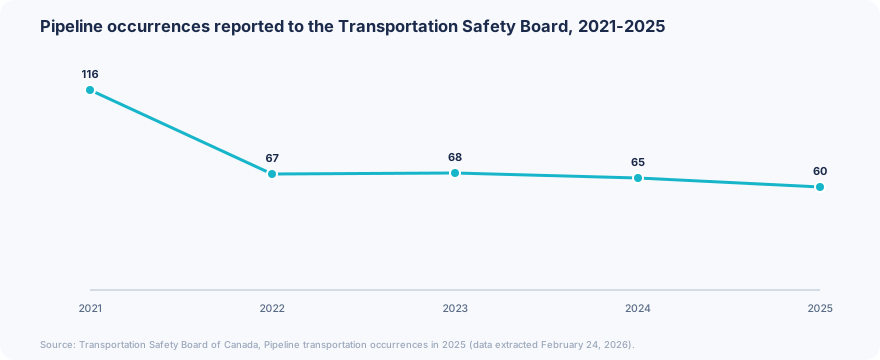
The public numbers on Canadian pipeline safety trend the right way, and that makes the record more important, not less. The Transportation Safety Board's summary of 2025 pipeline occurrences reports 60 occurrences on federally regulated pipelines - all incidents, no accidents - at a rate of 0.9 per 1,000 kilometres against a ten-year average of 1.3, continuing a long decline from 116 occurrences in 2021. Twenty of the 60 involved a release of product, up from 13 in 2024. A curve like that is not luck; it is the visible output of inspection programs, integrity management and replacement spending, all of which exist as records long before they exist as results.
Regulators are now asking for the data layer, not just the outcome
The Canada Energy Regulator's Regulatory Framework Plan for 2025 to 2028 sets out a Regulatory Asset Data project: regulated companies are asked to submit enhanced digital geospatial and physical asset information - pipelines, pumps and compressor stations, meters and more - to be integrated into CER systems, with completion estimated for late 2026. Its stated purpose is a comprehensive picture of buried and above-ground infrastructure supporting compliance verification, oversight planning and risk modelling, emergency management, and verification of abandonment cost estimates. That is a meaningful shift: a company is no longer only reporting what happened on its system, it is handing over a structured description of the system itself. Utilities whose asset records are fragmented across departments, vendors and legacy systems will feel that first as a data-quality problem, and second as a credibility one.
How XNM helps
XNM helps utilities pull the asset and integrity record into one governed command centre - as-builts and revisions, inspection and integrity results, maintenance and repair histories, capital and replacement decisions, and the approvals behind each, organized by asset and by project and kept current. Where it helps, the XNM-Vision platform gives an asset-management team and its board one line of sight across a network's whole documentary life, so a regulatory submission, an incident review or a rate filing draws on a complete record rather than a scramble across departments. The aim is not to replace an operating or geospatial system; it is to make the governed evidence behind those systems findable, current and defensible - standing in days rather than the months a records program usually takes.
Practical takeaways
Treat the asset record as a regulatory deliverable. When a regulator asks for structured asset data, its quality is your quality; fragmented records show up as gaps to explain.
Keep condition evidence with the asset, not with the vendor. Inspection runs and integrity results belong in your own governed record; a contract ending should never take your evidence with it.
Document the decision not to act. Deferring a replacement is a decision that must be as well evidenced as making one; prudence is judged years later on what you knew and recorded.
Assume the file will be read under pressure. Incidents, outages and hearings do not wait; a record only counts if it can be produced quickly and stands up when it is.
FAQ
We already have GIS and an asset-management system. Isn't the record covered?
Those systems hold structured operating data extremely well. The gap is usually the surrounding evidence - the scanned as-built, the vendor's inspection report, the board approval for a deferral - which sits outside them. The value is having that evidence governed and tied to the same asset, so a question can be answered once instead of assembled from four places.
Much of our network predates our current systems. Is a complete record realistic?
Complete for every legacy segment on day one, no. But the record can be current and defensible where it matters most - highest-consequence assets, anything in a capital or replacement plan - and improved from there. The practical goal is that nothing important is unfindable, not that everything is digitized.
The bottom line
Networks age; scrutiny does not. Safety performance, regulatory standing and prudence in a rate case rest on records created long before anyone needed them. Keep the asset's documentary life in one governed place, and the hard questions meet an answer instead of a search.