When the Roof Can't Wait: Why a School District's Repair Backlog Is a Records Problem
Every school board lives with a version of the same question on a hot September afternoon or a cold January morning: which building gets the money first? The roof that leaks, the boiler that is one winter from failing, the portable that was meant to be temporary a decade ago. It is tempting to think the constraint is funding, and funding is real. But the harder constraint underneath it is visibility - a board can only prioritize the repairs its condition record can actually see, and for many districts that record is older and thinner than the buildings it is supposed to describe.
A school district is a capital portfolio that happens to teach children. Dozens or hundreds of buildings, each with its own roof, mechanical and electrical systems, envelope, accessibility status, and decades of additions and renovations - documented, if at all, across facility-condition assessments, maintenance logs, capital plans, warranty files and the knowledge of facilities staff who have walked those halls for years. When that record is scattered or stale, deferred maintenance compounds quietly: a small repair postponed because no one flagged it becomes a major capital failure, and the board discovers the true condition of a building only when something breaks.
Recent context
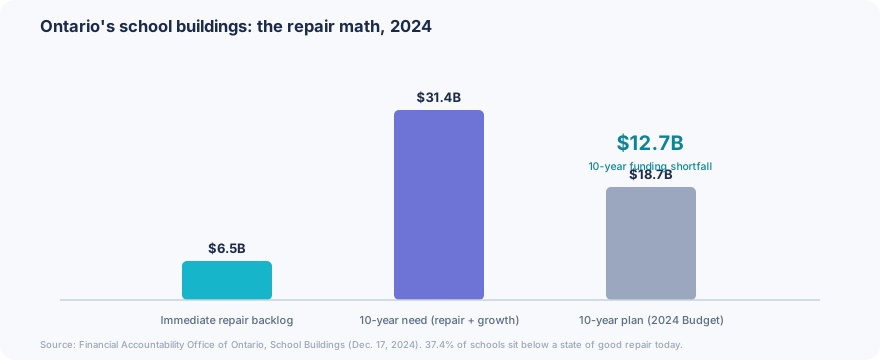
The scale is now measured. The Financial Accountability Office of Ontario reported in December 2024 that 1,813 schools - 37.4% of the province's total - sit below a state of good repair, with an immediate repair backlog of $6.5 billion. Keeping schools in good repair and addressing growth over ten years would cost $31.4 billion, while the 2024 Budget's capital plan provides $18.7 billion - a $12.7-billion shortfall. On the current trajectory, the FAO projects the share of schools below good repair would nearly double, from 37.4% to 74.6% by 2033-34. The backlog is not holding; it is accelerating.
Deferred maintenance is a data problem before it is a money problem
It is natural to read these numbers as purely a funding shortfall, and more capital would help. But no amount of new money is spent well against a thin record. Prioritizing billions in need across hundreds of buildings - which roof fails first, which boiler moves up the list, which school is one inspection away from a closure order - is impossible without a current, trustworthy picture of what exists and what condition it is in. The cost of a weak record is paid twice: once when a board funds the wrong project because the worse problem was invisible, and again when a deferred repair escalates into an emergency capital cost that crowds out everything behind it. The boards that stretch every dollar are the ones whose condition data is current enough to direct it.
How XNM helps
XNM helps school districts pull the facilities and capital-project record into one auditable command centre - condition assessments, maintenance histories, capital plans, drawings, warranty and contract files, and the board decisions behind each project, tied together and kept current. Where it helps, XNM-Vision gives a facilities director or superintendent a single line of sight across every building, so the repair list is built on evidence rather than the loudest complaint or the most recent emergency. When a funding application, an auditor, or a board committee asks why this school and why now, the answer already exists in a defensible form. And because it stands up in days rather than the many months a records overhaul usually takes, the visibility arrives in time to shape the next capital budget, not the one after it.
Practical takeaways
Treat the condition record as core infrastructure. A repair plan is only as good as the record of what you own; an out-of-date assessment quietly mis-prioritizes every dollar.
Tie condition data to the capital decision it drives. Facility-condition assessments exist to build the repair list - keep them where the budget is built, not in a consultant's PDF nobody reopens.
Make the capital file audit-ready by default. Provincial funders and auditors will ask what was approved and why; hold the record in a state where the answer is already there.
Give leadership one portfolio view. A board overseeing hundreds of buildings needs a single current picture, not a binder per school refreshed once a year.
Capture facilities knowledge before it retires. When a long-serving facilities manager leaves, the building histories should stay with the district, not walk out with them.
FAQ
We already commission facility-condition assessments. Isn't that enough?
An assessment is a snapshot; the record is what keeps it true. Condition data built on a one-time survey drifts out of date as buildings age and repairs are made or deferred. The value is a living record where condition, work history and capital decisions update together - so the repair list reflects the schools as they are now, not as they were at the last assessment cycle.
Isn't this really just a funding shortfall?
Funding is part of it, but visibility is the part the board controls. New money spent against a thin record buys less repair than the same money spent against a clear one. Getting the record right is how you make every dollar - existing or new - reach the building that needs it most before a deferred repair becomes an emergency.
The bottom line
A $12.7-billion gap and a backlog on track to double are a governance story before they are a construction story. The districts that will hold the line are the ones that can see their own buildings - every roof, boiler and system, its condition, and the decisions shaping its future in one current, defensible record. You cannot fix what you cannot see, and for a school board the condition record is how the worst problem stops hiding until it breaks.