The File Is the Audit: Why Inspection-Ready Records Decide an Accounting Firm's Standing
Long after the financial statements are signed and the client has moved on, an audit can be reopened - by a regulator's inspection, a restatement, a lawsuit, or a successor firm's questions. When that happens, the work itself is not what the firm gets to defend. What it defends is the file: the working papers, the evidence obtained, the judgments documented, the consultations recorded, and the approvals that show the right people signed off at the right time. In assurance, the engagement file is not a record of the work. For practical purposes, it is the work - because it is the only version of the work anyone can later examine.
That file is also where quality is won or lost. A firm runs dozens or hundreds of engagements a year, each generating planning memos, risk assessments, test work, third-party confirmations, management representations, review notes and final sign-offs - across teams, busy seasons and staff who rotate. When the complete, current engagement file is not obvious and instantly retrievable, the firm is exposed in the three places that matter most: a regulatory inspection that samples files years later, a dispute in which the firm's defence is only as good as what it can produce, and the daily reality of reviewers who cannot supervise what they cannot see.
Recent context
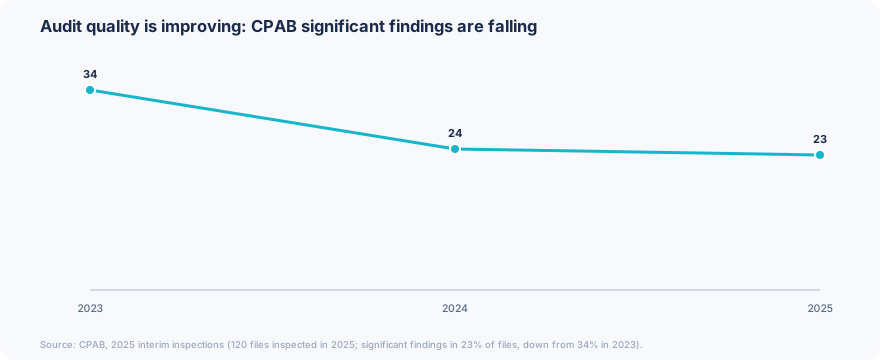
The trend is encouraging, and it is built on documentation. The Canadian Public Accountability Board reported in October 2025 that significant findings appeared in 23% of the 120 audit files it inspected, down from 24% in 2024 and 34% in 2023 - a steady improvement in audit quality. CPAB's recurring inspection themes - the use of technology in audits, fraud risk identification and response, group audits, and the evaluation of accounting policies - are, at bottom, about whether the work and the judgment behind it are properly evidenced in the file. Better audits and better files are the same project.
Audit quality is a records discipline in a suit
Strip assurance down and a significant inspection finding is usually not a wrong answer; it is work that was done but not sufficiently documented, evidence that was obtained but not retained, or a judgment that was sound but unsupported in the file. That reframing matters because it points to something a firm directly controls. You cannot eliminate a hard accounting estimate or a difficult client, but you can guarantee that every engagement is built as a complete, current, retrievable record as the work happens - so the file that an inspector samples in three years tells the whole story without a reconstruction. The same discipline does double duty on the liability side. Professional standards and limitation periods mean an engagement can be examined long after closeout, and a file reassembled from personal drives and inboxes after a demand arrives is the weakest possible position. A complete, time-stamped engagement file is the strongest - and it is the difference between defending the work and merely describing it.
How XNM helps
XNM helps accounting and audit firms put the whole engagement record into one auditable command centre - working papers, evidence, confirmations, consultations, review notes and approvals, organized by engagement and kept current with a clear retention trail. Where it helps, XNM-Vision makes the complete, current file unmistakable, preserves the version and review history behind it, and keeps the engagement defensible long after the opinion is issued - so reviewers can supervise in real time, the firm can meet an inspection or a successor request with a complete file, and quality stops depending on which manager happened to keep good folders. The aim is not another drive to search; it is the single governed record on which audit quality, inspection readiness and the firm's standing all rest - stood up in days, not the months a records project usually drags into.
Practical takeaways
Build the file as you do the work, not after. An engagement documented in real time is an engagement you can defend; one reconstructed at inspection time is a risk you have already taken on.
Keep the review trail, not just the final file. Who reviewed what, and when, is the evidence of supervision - and it is exactly what an inspection or a claim turns on.
Treat retention as a system, not a habit. Standards set how long files must live and intact; make retention automatic so no engagement ages out or goes missing.
Make quality independent of individuals. If a clean file depends on one diligent manager's folders, quality is fragile - put the discipline in the system, not in a person.
Assume the file will be examined years out. Inspections, restatements and claims arrive late; keep every engagement complete and retrievable so a future look meets a defence, not a scramble.
FAQ
We follow our methodology and document our work. Isn't the file already complete?
Methodology defines what should be in the file; the question is whether it reliably is, for every engagement, and whether you can retrieve it on demand years later. The gap that drives findings is rarely the intent to document - it is work scattered across drives, a review note that never made it in, or a file that aged into inaccessibility. A governed record closes that gap by design.
Does tighter documentation slow the team down in busy season?
The cost runs the other way. The time tax is in chasing evidence before an inspection, reconstructing a file under deadline, and re-doing supervision that was never captured. A single current engagement record removes that friction - and it pays for itself the first time it turns an inspection sample or a claim into a complete file instead of a fire drill.
The bottom line
Audit quality in Canada is improving because firms are getting better at evidencing their work, and the regulator's own numbers - findings down from 34% to 23% in two years - track that discipline. The firms that hold their standing are not the ones with the cleverest methodology; they are the ones whose engagement file was never in doubt. The file is the audit. Keeping it complete, current and retrievable is how a firm protects its quality, its clients and its name in the same move.