The Grant Ends, the Record Doesn't: Multi-Funder Reporting as a Records Discipline
Most non-profit leaders have lived this moment: a final report is due, a funder wants to see exactly how a years-old grant was spent against the budget it approved, and the answer is scattered across an old drive, a departed staffer's inbox, and a spreadsheet nobody fully trusts. The work was real and the money was well spent - but proving it is now a scramble. The grant ended long ago. The obligation to account for it did not. For an organization that runs on funded programs, the record is not back-office housekeeping; it is the thing that keeps the funding flowing.
A non-profit running multiple grants is, in effect, managing a portfolio of overlapping accountability clocks. Each funder brings its own budget categories, eligible-cost rules, reporting cadence, and retention requirements - multiplied across federal departments, provincial programs, foundations and donors, each tracked against a different agreement. When the record of what was spent, on what, with which approval, lives in different formats in different places, the burden lands hardest exactly where capacity is thinnest: small finance teams reconstructing eligibility line by line, program staff pulled off delivery to assemble reports, and an executive director signing an attestation they cannot fully verify.
Recent context
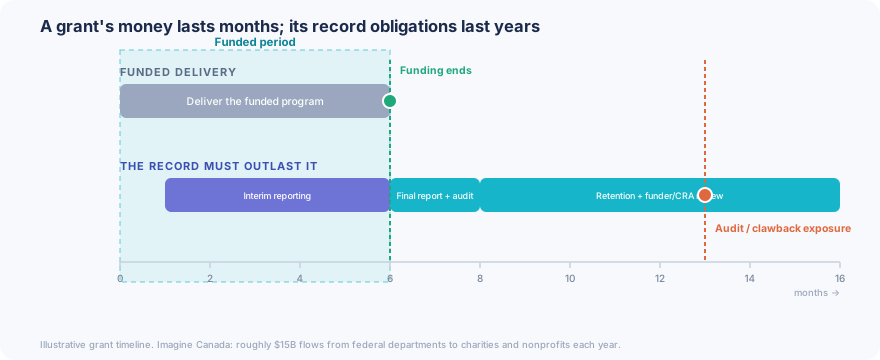
The scale of the dependency is real. Imagine Canada notes that roughly $15 billion flows from federal departments to charities and non-profits each year, and the sector has long flagged that reporting requirements often do not scale to the size or risk of a grant - the same accountability burden falls on a small community organization as on a large one. That makes the record a survival issue: when the obligation to report, be audited, and retain files is fixed regardless of an organization's size, the only protection is a record that meets it without consuming the program.
Grant accountability is a records discipline before it is a finance task
It is tempting to treat reporting as a finance chore that happens at the end. But the real determinant of whether a final report is painless or perilous is whether the record was built as the work happened - every eligible cost coded to the right grant, every approval and variance captured, every deliverable evidenced against the agreement that funded it. Reconstructing that after the fact, from memory and scattered files, is where errors, ineligible-cost findings, and clawbacks live. And the obligation does not end at the final report: most agreements carry a retention window during which a funder or the Canada Revenue Agency can still examine the file, sometimes years later. A complete, current record turns each of those moments - the interim report, the audit, the retention-period review - into a retrieval rather than a reconstruction. The organizations that keep winning funding are the ones whose accountability is visible on demand.
How XNM helps
XNM helps non-profits and foundations pull the grant record into one auditable command centre - agreements, budgets, eligible-cost documentation, approvals, deliverables, interim and final reports, and the retention trail behind each funder, organized by grant and kept current. Where it helps, XNM-Vision gives an executive director or finance lead a single line of sight across every funded program, so reporting is a draw-down from an existing record rather than a fire drill, an audit meets a complete file, and the same evidence can be reported to multiple funders without rebuilding it each time. Because it stands up in days rather than the many months a records project usually takes, the visibility arrives in time for the next reporting deadline - and frees the team to spend its hours on the mission, not on assembling proof of the mission.
Practical takeaways
Build the grant file as you spend, not at report time. A record assembled in real time turns a final report into a draw-down; one reconstructed at the deadline is where ineligible-cost findings hide.
Code every cost to its grant and its rule. Eligibility is decided line by line - capture the grant, category and approval at the moment of spend, not months later from memory.
Treat retention as part of the grant, not an afterthought. Funders and the CRA can revisit the file years out; keep it complete and retrievable through the whole retention window.
Report once, reuse everywhere. The same deliverable often satisfies several funders - hold the evidence once, in a governed record, and report from it rather than rebuilding per funder.
Protect the record against turnover. When a program or finance lead leaves, the grant history should stay with the organization, not depart in their inbox.
FAQ
We account carefully for every grant in our books. Isn't that enough for reporting?
Clean books tell you the totals; a grant record tells you the story behind them - which cost was eligible under which agreement, who approved it, and what deliverable it bought. Funders and auditors ask for that narrative, not just the ledger. The value is a record where the financial entry and its supporting evidence live together, so the report writes itself and survives a later look.
Our grants are small - is this level of discipline really necessary?
It matters most when grants are small, because the reporting burden often does not shrink with the dollars. A small team carrying the same accountability as a large one cannot afford to reconstruct files under deadline. A governed record is how a lean organization meets a fixed obligation without pulling staff off the work the grant was meant to fund.
The bottom line
A grant runs two clocks: the money spends in months, the accountability runs for years. The non-profits and foundations that keep their funders' confidence are not the ones with the most heroic year-end scrambles; they are the ones whose record was complete before anyone asked. The grant ends, but the record doesn't - and keeping it whole, current and retrievable is how a mission-driven organization protects both its money and the trust that brings the next grant.